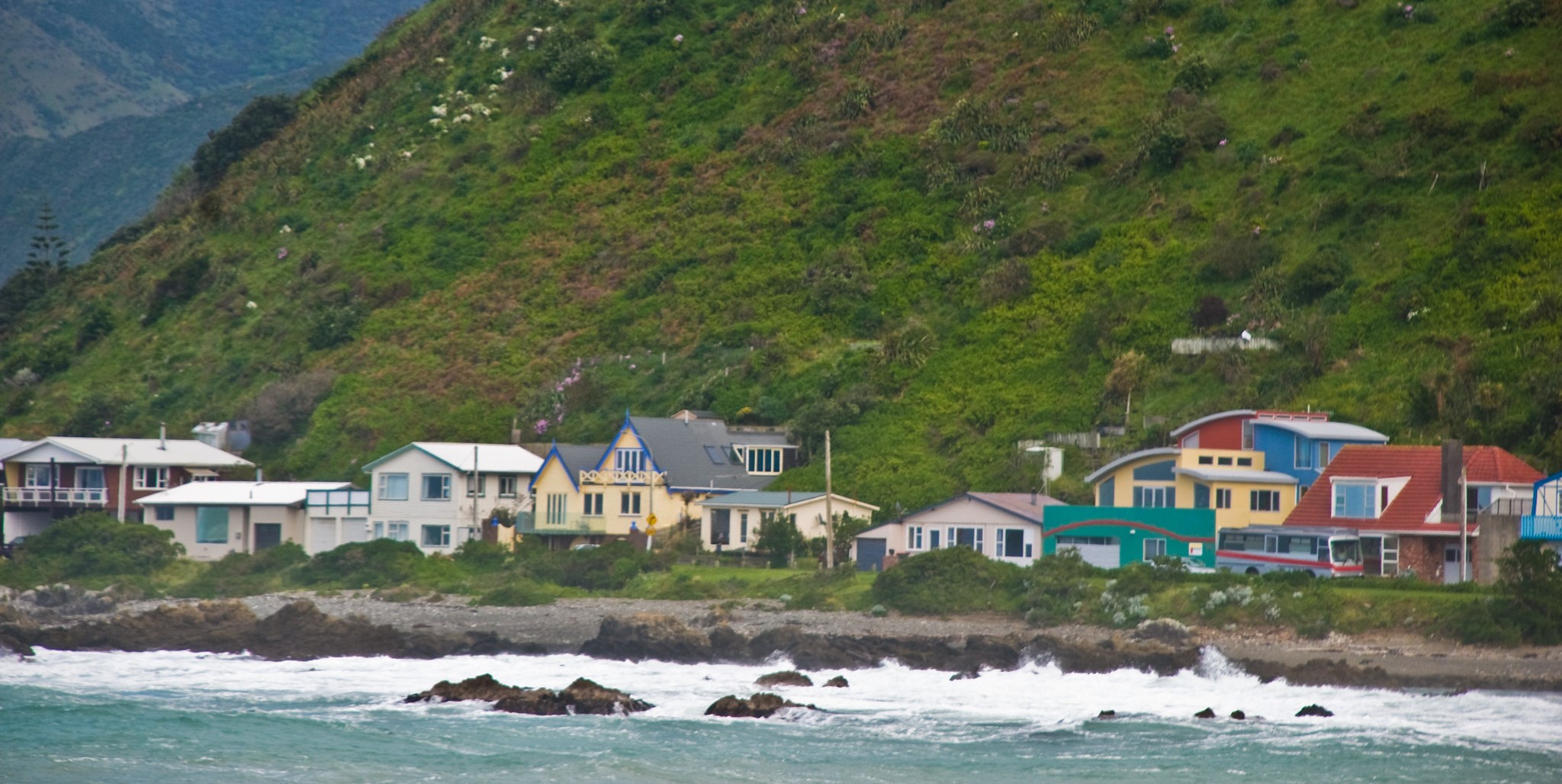
In around a century, Wellington’s 1-in-100 year coastal floods have become roughly a twice-per-year occurrence, a new study shows.
The researchers analysed tide gauge records from 130 sites worldwide, looking at the change from 1900 to 2005. Around the rest of the world, 1-in-100 year floods had a median increase to a 1-in-8 year event over this time. Another study also shows human-caused sea-level rise is responsible for 58% of extreme water levels around the world.
It comes as Wellington recovers from a state of emergency after huge swells hit parts of the city.
The Science Media Centre asked experts to comment.
Professor Tim Naish, Chair of the World Climate Research Programme and Professor of Antarctic Science at Victoria University of Wellington, comments:
“Coastal flooding risk is dominated by the frequency and magnitude of extreme sea-level events that occur when a storm surge coincides with high tide as we have just experienced this week along the south coast of Wellington. This hazard is made worse on the background of the long-term trend in global mean sea-level rise, which has been 20cm since 1900. Successive IPCC reports show coastal flooding increases exponentially for every increment of global sea-level rise. This is often measured as the annual exceedance probability, and can be thought of as the likelihood a damaging coastal flood will occur in a given year. With a further 30cm of sea-level rise above 2005 levels the historical 1 in 100 year coastal flood will happen every year in many places around Aotearoa’s coastline – and for most places this will be happening by 2060. I’m writing this comment from an international sea-level science conference in Montreal which is developing science for the next IPCC Report. Some of the authors of the two new studies are presenting this work at this meeting.
“These papers present the results of what climate scientists call detection and attribution studies used to identify how much human activities are responsible for climate change impacts, such as coastal flooding. These two peers provide compelling evidence evidence that humans have caused both the long-term rise in global mean sea-level and the increased frequency of extreme flooding events. For example, human greenhouse gas emissions are responsible for 97% of the observed sea-level rise and 58% of the increases in extreme sea-level events that occurred between 2000-2018. The studies show that the frequency of the 1-in-100 year coastal flood has tripled or even quadrupled since the 1960s, and the frequency will continue to increase, amplifying the risk.
“For communities and infrastructure near present day sea-level, this means that once manageable nuisance flooding (such as presently occurs on the south coast of Wellington), becomes a difficult to manage chronic flooding risk, that will require an adaptation response such as lifting floor elevations, building sea-walls or physical relocation of infrastructure and buildings. As I said above, this adaptation threshold will be crossed by the middle of this century, but it can and must be planned for – there is still time if we act soon. The risks and potential solutions are clearly outlined in New Zealand’s Coastal Hazard’s Climate Change Guidance. These recent studies provide another wake-up call to councils, central government and the insurance sector to work together and take a long-term view to adaptation plans that will build sustainable long-term resilience, and get us out of the disaster response cycle.”
Conflict of interest statement: No statement received.
James Renwick, Professor of Climate Science & Physical Geography, Victoria University of Wellington, comments:
“These new papers show that as global sea levels rise because of human-induced climate change, we are seeing changes in relative and extreme sea levels regionally and locally.
“Sea levels are not rising uniformly around the world, and local sea level changes depend on local vertical land movement and other factors. Yet, the climate change signal is now detectable worldwide and is responsible for the majority of daily extreme water level exceedances this century.
“At many locations studied, the 1-in-100-year extreme sea level event is now occurring at least once per decade. Sea levels are continuing to rise so coastal inundation events will be happening even more frequently over time from here.
“As noted in the Nature paper, this is happening now, not in some distant future, underscoring the need for urgent adaptation.
“This week’s extreme wave event on the Wellington south coast reinforces the idea that we need to act now and develop response plans urgently. I trust our policymakers and politicians are listening.”
Conflict of interest statement: “None. Note that I have received government funding for climate change research for many years and was a Climate Change Commissioner 2019-2024.”
Dr Rob Bell, Research Associate, Environmental Planning Programme, The University of Waikato, comments:
“Both new papers provide consistent global evidence that sea-level rise is increasingly the primary contributor to escalating extreme coastal flood levels along the world’s low-lying coastal areas and harbour margins. We even now have “sunny-day tidal flooding” on high spring tides in a few low-lying parts of NZ and worldwide (e.g., Florida), which demonstrates the increasing effect of the rising sea.
“Extreme sea levels are reached during storms when a high tide combines with a storm surge (technically called a storm-tide) riding on the back of both the seasonal cycle in mean sea level (slightly higher in late summer) and increasingly the average sea level being ratcheted up by climate change. In parts of NZ, subsiding land movement at the coast has further contributed to the amount of sea-level rise being experienced.
“Over the past 15 years, NIWA colleagues and myself have been taking a deeper dive into the tide gauge data for our main port centres in Aotearoa NZ. These two new papers provide an overview globally where sites can be compared in a relative sense, but the local analyses provide more in-depth data that can be used for engineering design (eg, roads, airports, ports) and adaptation planning.
“The key result for Wellington from the 2015 PCE report we assisted with, and in Chapter 4 of the 2021 Climate Aotearoa book, is that the 1/100 year (1% chance per year) coastal storm-tide level of the past few decades will become an event that on average occurs once a year, with only a modest sea-level rise of 0.3 metres (by the 2050s). This echoes the recent finding of the Nature article – although their baseline for the change in frequency is a way back in 1900.
“Why such a rapid escalation for Wellington (with the rest of NZ not far behind)? It stems from two components that make up storm-tide levels: a) Wellington’s tide range is quite small; b) the range of NZ’s extreme storm-tide levels is also relatively small on a global scale, as we don’t have hurricanes or tropical cyclones. Consequently, with these small contributors to coastal flooding, even a small amount of sea-level rise (and/or land subsidence) can make rapid changes in the frequency of these events.
“The recent papers and our earlier analyses don’t explicitly include wave run-up (as experienced at times on the South Wellington coast). However, the same principle applies, that as sea level rises, there will be more frequent wave overtopping events – and more so if riding on the back of a wider regional storm-tide.”
Conflict of interest statement: “I retired from NIWA 5 years ago and manage my own climate-adaptation consultancy (Bell Adapt Ltd). I have not received any research funding since 2024. I am a Research Fellow in the Environmental Planning Programme, Te Kura Toi School of Arts, University of Waikato, Te Whare Wananga o Waikato.”
Dr Scott Stephens, Chief Scientist Multihazard Risk and Resilience, Earth Sciences New Zealand, comments:
“Both studies use long-term tide-gauge records to examine how extreme sea levels that cause coastal flooding have changed over time, and why. They define an “extreme” level from observations, then show these levels are being exceeded more often. The key reason is that mean sea level is rising, so the same tides and storms now start from a higher baseline and more often cross damaging thresholds.
“The studies then estimate how much observed sea-level rise comes from human causes, mainly greenhouse-gas-driven ocean warming and land-ice melt, versus natural influences. They use models and physical understanding to remove the human-driven component and recalculate how often extremes would have occurred without it. This allows a direct comparison between the real world and a world without human-caused sea-level rise.
“Both papers conclude that sea-level rise is the main driver of increasing extremes, and that much of this increase is attributable to human influence.
“The reason the Dangendorf paper finds that Wellington experiences more extremes than many other locations is not because sea-level rise is larger there, but because the tides are relatively small in Wellington. So the same amount of sea-level rise produces a larger increase in exceedance frequency. Other parts of New Zealand with higher sea level variability do not experience the same level of increase as Wellington.
“What does this mean for New Zealand? The findings are consistent with previous New Zealand research (e.g., PCE 2014; PCE 2015; Stephens et al. 2018). Sea level has risen about 20 cm around our country over the last century and this is raising the base for storm-tides and waves to attack the coastline and cause flooding and erosion. Sea-level rise of about 1 m, or even more, is projected by the end of the century. So, areas that experience coastal hazards now, such as Wellington’s South Coast, are likely to experience worse impacts in the future.”
Conflict of interest statement: No declaration received.