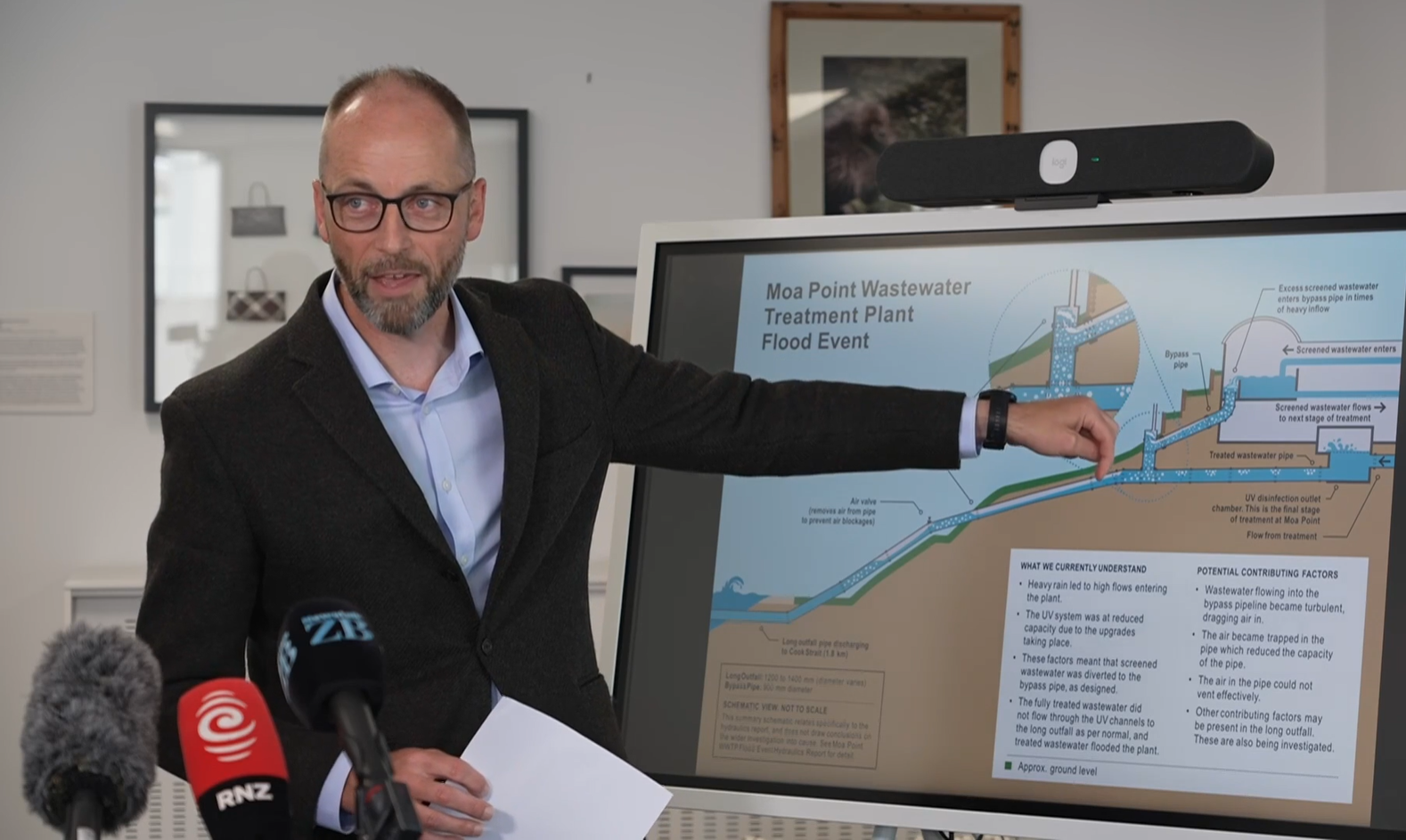
Trapped air bubbles causing wastewater to back up, are suspected to be behind the catastrophic failure of Wellington’s Moa Point treatment plant.
The news comes from the hydraulic report into the Moa Point failure, released today.
The SMC asked experts to comment.
Associate Professor Hamish Mackey, Department of Civil and Environmental Engineering, University of Canterbury, comments:
“The Stantec Moa Point Wastewater Treatment Plant Flood Event Hydraulics Report, which includes hydraulic modelling and an assessment of the outfall system, indicates that the most probable mechanism contributing to the Moa Point Wastewater Treatment Plant failure was air entrainment within the bypass system. This process can allow pockets of air to accumulate within the outfall in an area where air-release valves were not installed, restricting flow and causing water to back up through the system. The analysis suggests that the configuration where the plant’s main bypass reconnects with the ocean outfall may enable air to be drawn into the flow and carried downstream without an effective means of release.
“The findings point toward a design-related vulnerability rather than issues associated with day‑to‑day operations or levels of investment. The report also notes a few recent instances, in 2025 and 2026, where elevated flows caused the system to back up to the outlet of the UV disinfection process—located immediately upstream of the bypass connection. Earlier escalation of these observations may have prompted a more detailed review of system behaviour, although it remains uncertain whether such a review would have identified measures capable of preventing the event in a sufficiently timely manner.
“It is also notable that Stantec’s HADES hydraulic modelling software did not predict an overflow or even back-up scenario. HADES has been developed and refined over more than two decades and is capable of analyses far more sophisticated than those available when the plant was originally designed in 1995. While the model highlighted areas of potentially high velocity within a chamber, it was only through post‑event analysis—combining hydraulic modelling, condition assessments, and real‑time data logs—that the likely cause was identified. Stantec has recommended further advanced computational fluid dynamics modelling, including three‑dimensional and transient simulations, to validate these conclusions. This is because the modelling tools used, although highly capable, cannot fully capture the small‑scale variations and inherent randomness in fluid behaviour that can lead to non‑ideal or transient flow conditions.
“Overall, the report and the event itself underscore the importance of ongoing risk assessment and resilience planning for critical infrastructure. They also highlight the need for continued investment in developing and maintaining specialist expertise in water and wastewater treatment across the country.”
Conflict of Interest statement: Dr. Mackey was employed by MWH (now Stantec) from 2007 to 2009, prior to his academic career. During that time, he undertook work involving wastewater treatment plant hydraulic modelling using Stantec’s in‑house HADES hydraulic modelling software.
Andy Shilton, Emeritus Professor of Environmental Engineering, Massey University, comments:
“I have heard comments that this outage is symbolic of a chronic underinvestment in wastewater treatment infrastructure in NZ. It is absolutely true there is far too much non-compliance and an urgent need to rapidly upgrade wastewater disinfection throughout New Zealand. But I think pointing to that as the issue here is not the case.
“The Wellington system is actually a very good system by international standards. The system is designed to screen, settle, biologically cleanse and then UV disinfect the liquid before discharging out a long outfall into currents that highly dilute it. By international standards that’s top level.
“When it comes to wastewater treatment, the most fundamental requirement our communities want is to interact with waterways without making them or their families sick. Wellington’s UV disinfection treatment plus the massive dilution and natural treatment that occurs after discharge would, under normal circumstances, do that to a very high standard.
“The recent report on the incident provides indication that air entrainment into the system could potentially have compromised the ability of the outfall to handle high flows. If that is the case, it is potentially good news as this is a much easier issue to solve than if there were problems far out in the deep water.
Questions have been raised about if this is a ‘design fault’. If this was a brand-new plant with immediate problems then that might be a fair question. But this is a plant that has operated well for decades, which points to the fact that there is a missing part to the puzzle – i.e. why now? There are other factors actively being investigated, such as environmental conditions and maintenance that perhaps, in combination with the air entrainment, have created a very unusual circumstance. This is the reality of engineering. Even within the best endeavors of very clever people, complex stuff happens that is not always easy to predict.
“For Wellington, an untreated sewage discharge close to shore is a very unfortunate event that they thought was solved when the Moa Point plant was built back in 1998 but will be resolved. The bigger and perhaps less reported issue NZ needs to deal with are hundreds of systems that are still discharging into NZs waterways without any disinfection at all.”
Note: “Andy has almost 4 decades of experience working as an engineering consultant, environmental research engineer, lecturer and most recently as the Chief Technology Officer of NovoLabs™ which is a multi-award winning company manufacturing a patented new type of UV disinfection system capable of effectively providing chemical free disinfection of liquids normally considered untreatable by legacy UV systems.”
Conflict of interest statement: “Andy works for NovoLabs which builds UV disinfection equipment.”
Professor James Bell, Professor of Marine Biology, Victoria University of Wellington, comments:
“While the recent Wellington wastewater report has begun to help understand what happened at the Moa Point wastewater facility on February 4th and 5th, 2026, it does little to recognise the potential for a major environmental crisis on the Wellington South Coast. Furthermore, its ecological implications extend well beyond immediate public health concerns. At this stage, more than 3 billion litres of untreated sewage have entered the Wellington South Coastline, and there is still no indication of when this will end.
“Following the catastrophic failure of the Moa Point treatment plant, vast volumes of untreated sewage were discharged into coastal waters, introducing a complex mixture of nutrients, bacteria, sediments, and microplastics into highly productive marine ecosystems.
“One of the most significant concerns is nutrient enrichment. Elevated nitrogen can stimulate turf algal growth, which may replace kelp forests. These kelp systems are critical “underwater forests” that provide habitat, food, and nursery areas for many species. International evidence shows that sustained nutrient loading can shift ecosystems from kelp-dominated systems to these simplified algal turf states, reducing biodiversity and ecosystem resilience. Such shifts may be difficult to reverse, particularly if urchin numbers then explode.
“Deeper reef systems are also at risk. Wellington’s deeper sponge gardens and bryozoan communities are especially vulnerable to sedimentation and organic loading. Fine sediments can smother filter-feeding organisms, while increased turbidity reduces light penetration, further stressing already light-limited systems. Because these organisms grow slowly, recovery could take years rather than months.
“While Wellington’s dynamic coastal environment may aid dilution, the scale, duration, and proximity of the discharge to ecologically important habitats mean the potential for long-term ecological change is significant. Furthermore, as we are heading into winter, there is a greater likelihood of heavy rain events, which will mean the short outfall pipe, which is very close to shore, will need to be used. This outflow pipe includes sewage that has no screening at all, so there is no removal of larger materials such as nappies, sanitary products, and wipes.
“We urgently need the Moa Point facility to be fixed so scientists and environmental management agencies can begin to assess any ecological impacts.”
Conflict of interest statement: No declaration received.
Associate Professor Ricardo Bello Mendoza, Department of Civil and Environmental Engineering, University of Canterbury, comments:
“The main conclusion is that the problem was caused by air trapped in the piping system, resulting in an airlock. This phenomenon occurs when a pocket of air (or gas) becomes trapped at a high point in a piping system, creating a blockage that disrupts or completely stops the flow of water.
“Even though the modelling approach used in the investigation (steady state, single phase) doesn’t fully describe the dynamics of the air-water interaction in the piping system, additional information, like the location and position of the bypass junction and observations of air burping, suggests that air causing a choke point is a sensible hypothesis.
“The experts have recommended installing additional air-release equipment at specific locations in the system, while the design of a new bypass pipeline can be developed and implemented.
“Going forward, it would be beneficial for the Moa Point and other wastewater treatment plants in the country to revise their risk assessment and mitigation plans, as well as the training operators receive, which should reflect, among other hazards, more intense and frequent rain events.”
Conflict of interest statement: No declaration received.
Dr Greg Leonard, civil engineer, School of Surveying, University of Otago, comments:
“Although I am not familiar with the particular hydraulic model (Hades) that was used in the study, it is common practice to use this type of model, i.e. a steady-state single-phase model, to represent wastewater flows through treatment plants and pipelines. However, as the authors of the report acknowledge, a steady-state model cannot accurately represent conditions where velocities and flow rates are changing rapidly in time, such as the conditions that occurred on 3-4 February at the Moa Point plant. As such, the authors of the report have drawn their conclusions about what the main drivers of the flood event were by contrasting the reported observations, such as flow rates and flow levels, with their model predicted outcomes. In essence they focus on areas in the plant, bypass and outlet pipelines where what happened during the flood event could not be predicted by their model. This is a sensible approach, but more complex modelling that is capable of resolving non-steady, 2-phase flow would be required to gain a more complete understanding of the flood event, as the authors noted.
Given the limitations of the modelling software used in the study, I think the report has identified a plausible set of factors that likely contributed to the flooding event on 3-4 February. Additional monitoring of the flow of wastewater at the plant coupled with more complex hydraulic modelling would provide a better understanding of the expected hydraulic conditions under different flow scenarios. I would suggest these could be worthwhile steps to take as plant operations move forward from the recovery phase.”
Note: “I currently teach the general principles of wastewater treatment in a module of a 400-level Surveying paper titled Land Development Management, and I was a consultant engineer from 2006 – 2008 where I was involved in designs of water supply, wastewater and stormwater systems.”
Conflict of interest statement: “I don’t have any conflicts of interest with the Moa Point plant that I am aware of.”