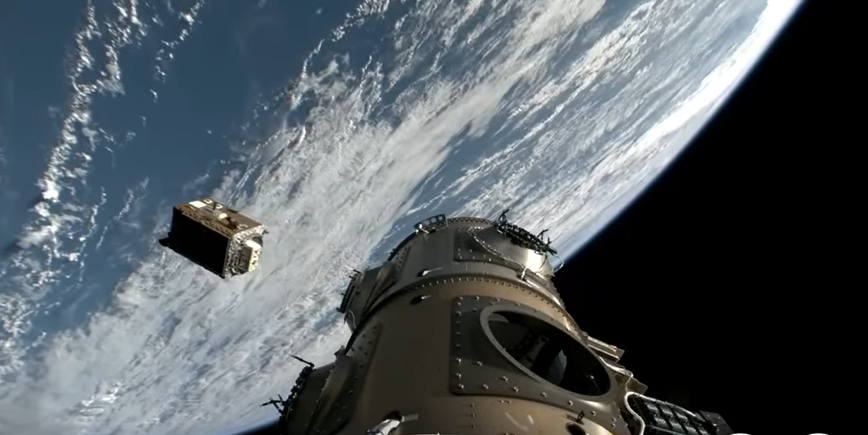
The US government is allowing SpaceX to launch up to a million satellites to serve as data centres.
The company gets seven years to launch the first, and until 2040 to launch the full ‘constellation’, which would mean a 50-fold increase in the number of satellites in orbit.
The SMC asked NZ experts to comment. Previous comments on NZ’s space launch limit and on orbital data centres are available.
Dr Preeti Cowan, Research Fellow and astronomer, University of Auckland, comments:
“For all of human history, we have looked up at the night sky and dreamed. Those dreams gave us a rich and diverse cultural history alongside everyday essentials like accurate navigation, Wi-Fi, and now satellites.
“Satellites themselves are nothing new, but the proposed orbital data centres are a different matter entirely.
“To meet their power demands, they will need to be far larger than existing Starlink satellites, carrying vast solar arrays and thermal radiators in orbits designed to maximise sun exposure. That means they will be significantly brighter than most satellites: easily visible to the naked eye and nearly blinding to sensitive facilities like the Vera C. Rubin Observatory.
“Deployed at the proposed scale, they will brighten the entire night sky, washing out far-away galaxies and nebulae and, perhaps more critically, blinding us to potentially hazardous near-Earth asteroids.
“The massive radiators needed to cool them will flood the sky with infrared radiation, while their electronics will leak radio noise that can drown out faint signals like those from the pulsars famously on Voyager I’s golden disc.
“We shouldn’t have to trade our view of the cosmos for computing power. Without clear safeguards, we risk blinding ourselves to the very skies that taught us to dream and made us who we are today.”
Conflict of interest statement: “No financial conflicts, only the obvious one: I’m an optical astronomer.”
Dr Michele Bannister, Rutherford Discovery Fellow and Associate Professor in Planetary Astronomy, University of Canterbury, comments:
“A million large satellites in low-Earth orbit will fundamentally change the sky as we know it. This is not the mild change of occasionally seeing a moving dot of light that currently people see, often near sunset or dawn, as the satellite reflects sunlight as it is high above while it is dark below. This is a blanket transformation to the entire planet’s sky.
“Previous studies have found that megaconstellation satellites among the current twenty-thousand-strong satellites already in Earth orbit are often bright enough to see by eye. These new satellites have huge solar panels and will certainly be bright enough to see, creating a moving grid-like net of dots of light in the sky. Their scattered reflected light will also make the whole sky less dark, particularly near twilight and lasting into the night. Astronomy depends on detection of the faint, the rare and the beautifully unusual aspects of the Universe: all will become harder to find and to measure.
“For the brand-new Vera C. Rubin Observatory in Chile, which just started its Legacy Survey of Space and Time in the last few weeks, and which New Zealand is involved in via the University of Canterbury and the University of Auckland, a study just last month showed this million satellites will cause widespread contamination. Simulations show up to 80% of its images will have streaks from lit satellites. Even partial build-out of the megaconstellation will be damaging.
“One country’s regulatory agency has made this decision. In an era of massive planetary change, whose responsibility is the sky?”
Conflict of interest statement: “No COI.”
Professor Laura Revell, Professor of Atmospheric Chemistry, University of Canterbury, comments:
“The FCC has granted SpaceX permission to begin arguably the largest experiment in atmospheric chemistry the world has ever seen. Over the next 14 years, SpaceX has been given the go-ahead to launch one million Starmind satellites. That would mean launching about 8 satellites per hour from now until their deadline to complete the authorized constellation of 25 November, 2040.
“Others have questioned the feasibility of putting that many satellites in orbit (for context, there are around 20,000 satellites currently orbiting the Earth), and the feasibility of a solar-power data centre.
“That aside, I am extremely concerned about the levels of pollution that would accumulate in the atmosphere. We already know that emissions from rocket launches can cause depletion of the protective ozone layer. To date, ozone depletion from rocket launches has been insignificant because launch rates, while climbing exponentially, are still relatively small. It is concerning to think that decades of work to protect the ozone layer could be undone due to the expected surge in launch rates.
“The other side of the coin is that these satellites are not designed to remain permanently in orbit. They are typically retired after 5 years. SpaceX had requested permission to dispose of some Starmind satellites by putting them on a ‘heliocentric orbit’, however the FCC denied this request. This means that they will be disposed – as we feared – by atmospheric re-entry, fundamentally turning the atmosphere into a crematorium for satellites.
“There are so many open questions around what happens in terms of atmospheric chemistry-climate interactions when satellites burn up. We do know that metals from burned-up spacecraft have already been found in the upper atmosphere – and with one million new satellites, the amount of metal-containing aerosol particles will grow. We don’t know what level of ozone depletion we will see or what the climate impacts will be. But with each satellite weighing up to a whopping 4000 kg each, we are sure to see something.
“The FCC dismissed environmental concerns as being outside their purview. The question is, who has the authority to protect the upper atmosphere from rocket and satellite pollution for the common good?”
Conflict of interest statement: “No conflicts.”
Dr Priyanka Dhopade, Senior Lecturer in the Department of Mechanical Engineering, University of Auckland, Director of the Sustainable Space Initiative, comments:
“On paper, this decision ticks every box for orbital congestion, environmental review, atmospheric impacts and end-of-life disposal.
“However, each box is ticked by setting the issue aside. Orbital congestion is set aside because there’s no rule on limiting satellite numbers. Environmental review is not required because space activity is treated as extraterritorial. Atmospheric impacts are deferred to another agency that reviews rocket launches, not the re-entry of up to a million satellites. The trickiest question of what happens to satellites above 600 km at the end of their lives has also been deferred. Up there, dead satellites can stay in orbit for centuries. SpaceX asked to move them into other orbits instead of bringing them down, but didn’t provide enough information.
“We could reasonably expect a decision of this scale to consider the whole picture. Instead, each concern has been assessed in isolation against what is in the Federal Communications Commission’s scope. Basically, compliance has been mistaken for judgement.
“This narrow view of sustainability puts at risk the orbits and upper atmosphere that every nation, including Aotearoa, and every future generation depends on.
“In New Zealand, every launch and payload needs an orbital debris mitigation plan before it’s approved, with no waivers. We should continue to lead by example, and advocate internationally for decisions that account for the full impact of space activity, rather than only what fits within the current rules.”
Conflict of interest statement: “I lead the Sustainable Space Initiative, a research group on space sustainability.”
Professor Randy Pollock, Chief Scientist/Engineer for Space Research, Robinson Research Institute, comments:
“The FAA’s rejection of the environmental concerns is disappointing. There is no need to rush into a project of this magnitude without understanding the implications.
“Placing data centres in orbit will have clear environmental consequences. Building and fuelling massive rockets creates pollution. Launching rockets creates local noise and atmospheric pollution – the latter which can drift for long distances downwind. At the end of the space data centres’ lives, they will mostly be directed to burn up in the Earth’s atmosphere – adding millions of tons of reactive metals with unknown impacts to atmospheric chemistry. A detailed study of the relative impact of space-based versus ground-based data centres is clearly warranted.
“In addition to the environmental concerns noted above, this proposal will fundamentally alter the night sky in a profound way. Already, the rapid growth in communication satellites is obscuring our view of the stars. Adding a million data centres will mean that there will be dozens or hundreds of spacecraft visible at any time. The dark sky we share now will be lost.”
Conflict of interest statement: Professor Pollock has declared he has no conflicts of interest.
Dr Kerry McInerney (Ngāti Ruanui), Lecturer in AI, University of Auckland, comments:
“It’s concerning to see that the FCC has approved the launch of up to 1 million orbital satellites by SpaceX. This lends more credence to a popular narrative about data centres in space, which is that they’re more environmentally friendly alternative to Earth-based data centres. However, data centres in space come with their own environmental costs, given that satellites have a number of related environmental issues, including pollution caused by satellite re-entry, noise pollution, light pollution, and space debris.
“Even more worryingly, this move has the potential to further concentrate power in the hands of SpaceX and its CEO, Elon Musk.
“SpaceX already owns and operates the majority of the world’s satellites. If we continue to travel down this road, the rest of the world risks becoming (even more) dependent on a small handful of American firms to provide our essential digital infrastructure.
“In their statement, the FCC’s Chairman explicitly said that “America is leading the world into the era of super intelligence. Under President Trump’s leadership, the United States is moving decisively to ensure that this breakthrough technology…This action opens a bold new frontier for the computing infrastructure needed to power America’s leadership and growth.”
“This shows how decisions about satellites, data centres, and other AI infrastructure aren’t solely technical: they’re also political, and inseparable from global power politics.”
Conflict of interest statement: “I have no real or perceived conflicts of interest.”
Professor Richard Easther, Department of Physics, University of Auckland, comments:
“The US government has authorised Elon Musk’s SpaceX to launch up to one million satellites over the coming years. These would be “Starmind” satellites, designed to carry out AI-related computing in space.
“There are many aspects to this decision, which include:
- The project sounds like science fiction, but it is at the very edge of technical feasibility. Fifteen years ago, the 10,000-satellite Starlink constellation would have sounded almost as implausible. Starlink is now used daily by tens of thousands of New Zealand households and is reported to be comfortably profitable.
- The Federal Communications Commission’s approval requires 10% of the satellites to be in orbit by 2035 and all one million by 2040. Musk and SpaceX have a history of setting ambitious targets and then missing them. This project relies on SpaceX’s Starship rocket (or future variants) to launch the satellites. Starship is a major technological advance, but its development is running years behind its original schedule.
- Each Starmind satellite could weigh up to 4 tonnes, so the whole fleet could have a mass of up to 4 million tonnes. For comparison, all the aircraft carriers in the US Navy together weigh a little over 1 million tonnes.
- If future versions of Starship can lift 200 tonnes to orbit, meeting the FCC’s deadlines would take around 10 launches a day, every day, between 2035 and 2040. That’s far beyond anything currently possible.
- A number of commentators on space-based AI data centres point to the difficulty of getting rid of the heat generated by the onboard computers. This is challenging, but there are plausible solutions that are entirely consistent with basic physics. However, space-based computing will certainly face additional challenges beyond its ground-based competitors, including radiation and servicing. It is far from clear that it is either technically or economically workable in practice.
- The environmental impact of satellite launches is currently much smaller than that of global aviation. Projects like this could change that, through the sheer number of launches and the material released into the upper atmosphere as the satellites eventually re-enter.
- This many large satellites would change the appearance of the night sky, particularly just after sunset and before sunrise. This effectively “redecorates” the night sky that is seen by all people in ways that will bring most benefit to a small fraction of humanity. It is also likely to have a devastating effect on many astronomical observations.
- A key issue is that the regulatory processes controlling what is launched into space were designed when satellites were launched one at a time, and they are clearly not keeping pace with technical change.”
Conflict of interest statement:”No COIs.”
Dr Ulrich Speidel, School of Computer Science, The University of Auckland, comments:
“SpaceX’s plans have been known for a while. AI data centres are power-hungry with current technology and require a lot of cooling. Putting data centres onto satellites and into space is somewhat attractive due to the higher availability of solar energy (depending on the orbit a satellite is in, the sun hits it for more than half the day and there are no clouds obviously).
“Cooling is a bit of an issue since the only way to get heat away from a satellite that orbits in effective vacuum is to radiate it away rather than conduct it away as we can do with water or air cooling here on Earth. This is a challenge that adds to the weight of each satellite.
“A million satellites is a lot even so – getting them up there will be very resource-intensive, also the higher they go, the more sunshine they can get each day, but the harder the communication with the ground becomes. So real-time processing might be a bit harder than on the ground.
“There is also the problem of avoiding collisions between the spacecraft – something SpaceX have so far been able to do with their Starlink satellites, but this proposal has two orders of magnitude more satellites involved.
“So quite whether we ever will see these million satellites up there is questionable. There’s the real risk of stranded assets as well, in case technology on Earth reduces the energy and heat issues of present-day AI hardware to the point where these no longer matter that much, and we can do a better and cheaper job here.”
Conflict of interest statement: “No conflict of interest.”