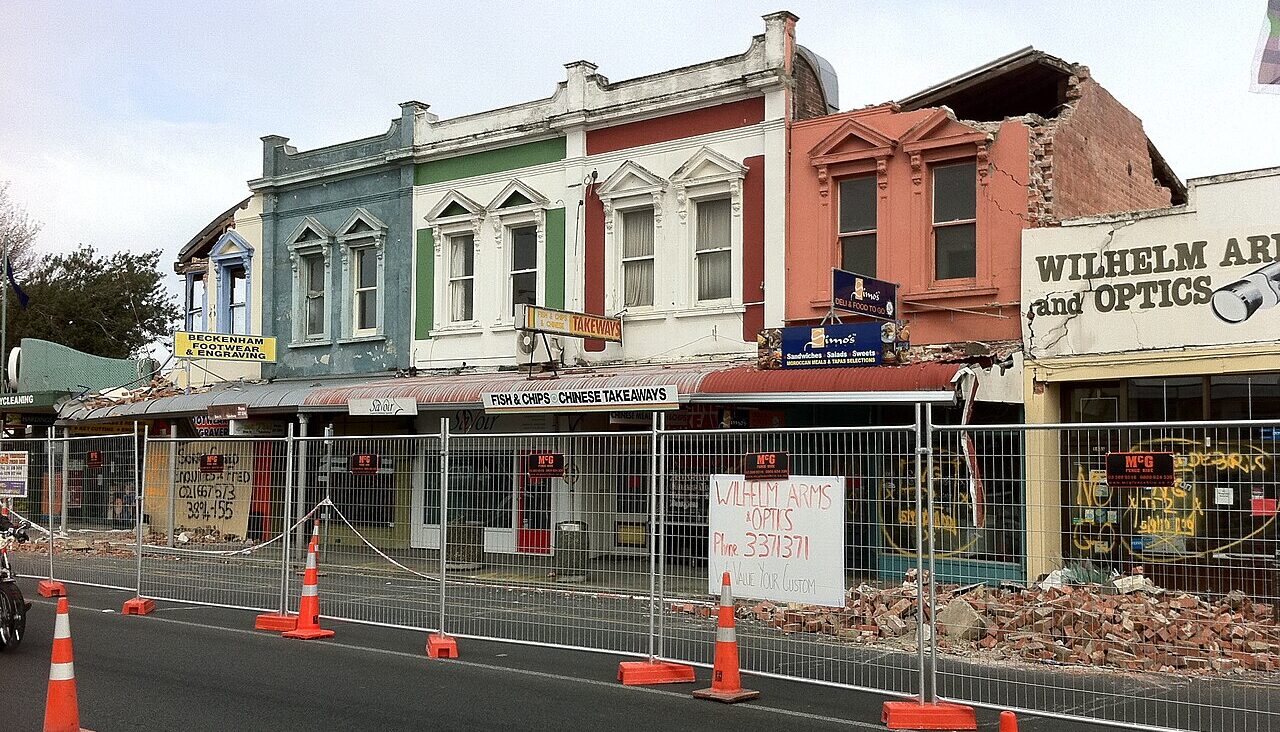
NZ-led research into large earthquakes shows they stop fast, with a sharp backwards movement.
Scientists studied 12 major earthquakes that moved along the ground (rather than up and down), using shaking data recorded near the faults.
They found that the whiplash-type stop was a common feature of the earthquakes, which included the 2010 Darfield and 2016 Kaikōura quakes, and say it should be included in hazard assessments.
The Science Media Centre asked the NZ author and independent engineering experts to comment.
Lead author Dr Jesse Kearse, Research Fellow in Earth Science, Victoria University of Wellington, comments:
“In this study, we looked closely at recordings from big earthquakes, including the 2016 Kaikōura earthquake, and found something new in the data.
“Right at the end of the quakes, the ground jolts strongly, creating a kind of extra shake. It’s a bit like when you’re in a car and the driver brakes hard; your body jerks forward and then snaps back as the car stops.
“This means that big earthquakes stop suddenly, rather than slowly dying out.
“This sudden stop can cause a whiplash effect for buildings. As the ground quickly changes direction, buildings sway one way and then snap back the other way. That sharp backwards motion can be large, up to one metre in the case of the 2016 Kaikōura earthquake. Such big movements can be difficult for tall buildings to withstand.
“By identifying this stopping phase, we can better predict these final jolts. We found that they are most likely to occur where there are bends or gaps in the fault lines, which helps us plan for these strong whiplash motions that happen in large earthquakes.”
Conflict of interest statement: Dr Kearse is lead author of this paper.
Professor Charles Clifton, Professor of Civil Engineering, University of Auckland, comments:
“We do design for these near fault effects in quite a few locations where specified in the Earthquake Loadings Standard, and this paper opens up more locations adjacent to a fault rupture where this “fault fling” effect, as it is sometimes called, is reported to occur.
“The design and detailing of new buildings in near fault regions is effectively the same as for buildings not in designated near fault regions, so we already design and detail our buildings to accommodate this effect, given that we don’t know in advance which fault will rupture. Many well designed, detailed and built new buildings withstood these effects in the recent severe earthquakes from 2010 to 2016 which were not in already designated regions for near fault design; this includes steel framed buildings with concrete slabs on steel decking and supported on a network of steel beams.
“This type of motion will subject these multistorey buildings to large displacements, with the potential to cause additional damage and our current building earthquake design procedures generally handle these demands well. It may be more of an issue for base isolated buildings not in currently designated near fault regions.
“There is an increasing focus on designing new buildings for increased resilience to the damaging effects of severe earthquakes, and this effect may make that more difficult to fully achieve in more regions adjacent to the strong shaking from a near fault than we currently consider. However, the response of these buildings will be satisfactory from a life safety viewpoint, which is the current requirement of the New Zealand Building Code and I expect this newly documented phenomenon won’t have a significant effect on the overall reliance of modern, well designed and built buildings. It may have a more adverse impact on retrofitted older buildings.”
Conflict of interest statement:;”I have no conflict of interest with regard to commenting on this paper.”
Dr Yusuke Mochida, Senior Lecturer in Engineering, University of Waikato, comments:
“Earthquakes that stop suddenly, or earthquakes in which the ground moves strongly in one direction and then snaps back in the opposite direction, can put a heavy strain on buildings. Tall buildings, such as high‑rise buildings, are especially affected. When the ground moves in this way, these buildings bend like a whip, and the top of the building moves much more than the bottom.
“Buildings are made of strong materials like concrete and steel, but even these materials have limits. They are weak when they are bent or pulled very quickly and by a large amount. If these limits are exceeded, cracks can form and parts of the building can break.
“Even buildings with base‑isolation systems, which are designed to reduce shaking, are not completely safe. If the ground moves more than the system is designed to handle, the isolation system can suddenly stop working. When this happens, a very strong shock can be sent directly into the building. This is similar to what happens to passengers in a car crash: even with seat belts, a sudden stop can cause a strong impact.
“Because of this, it is important to create safety standards that specifically and explicitly consider the effects on buildings of earthquakes with sudden stopping and/or large motions. To protect buildings, it is important to think not only about how strong an earthquake is, but also how quickly and how far the ground moves.”
Conflict of interest statement: “I don’t have any conflict of interest with the contents and the authors of the paper.”
Dr Shahab Ramhormozian, Associate Professor in Structural and Earthquake Engineering, AUT, comments:
“The influence of near fault earthquakes with forward directivity effects on buildings is typically more severe. This is because, in addition to high accelerations, such ground motions often impose large velocity pulses and permanent or near permanent large displacements (i.e. movements/shifts) in one direction, at the base of the buildings. One can imagine pushing building over a relatively large displacement in one direction during a short time interval. These characteristics can potentially lead to increased structural damage and residual displacements/deformations particularly if structural damage occurs in some locations of the structure during the earthquake. This paper mainly talks about observations and behaviour of such earthquakes.
“If an earthquake record, i.e. the shaking on the ground, terminates abruptly, as discussed in this paper, rather than exhibiting a more typical gradual decay (aka “wind down”) in ground motion, it may possibly be more damaging at least in some scenarios. For example, if a building is severely damaged and laterally displaced during a very strong shaking, the wind-down portion of that ground motion and aftershocks may very likely contribute to partial or complete re-centering of the building i.e. reduction of possible residual out of plumbness. The absence of such a decay phase may possibly be less desirable and could result in larger residual deformations, specifically if the building sustained damage during the earthquake resulting in such deformations.
“However, it is worth noting that the influence of a particular earthquake record on buildings, both in degree and in form, depends on several factors, including the dynamic characteristics of both the building and the ground motion. In other words, translating the effect of an earthquake record onto a structure requires consideration of both structural properties and ground motion characteristics. For example, low frequency (i.e. long period and relatively slow) earthquake records with large amplitudes (i.e. maximum values of the ground’s acceleration, velocity, or displacement) are generally and potentially more damaging to long period buildings, such as tall buildings or base isolated buildings, and are typically less critical for short period, stiff buildings which have relatively short natural periods. On the other hand, a high frequency ground motion may be more critical for a “short and stiff” building, and less so for a “tall and flexible” building.”
Conflict of interest statement: “None.”