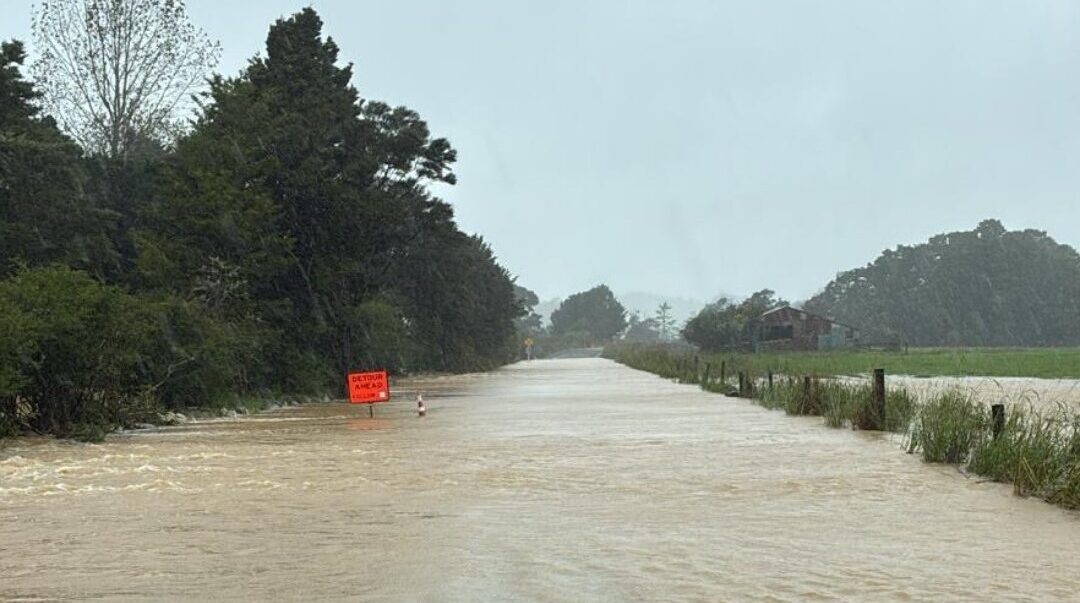
Northland and Auckland have been deluged in heavy rain, with some areas receiving more than a month’s average rainfall in just 24 hours.
Hundreds of people were evacuated last night due to extensive flooding in the Far North and many roads remain closed.
The heavy red rain warning for Northland has now been lifted, but orange warnings remain in place for other parts of the motu.
The SMC has gathered comments from climate and river experts.
James Renwick, Professor of Climate Science, Victoria University of Wellington, comments:
“This kind of exceptional rainfall is exactly what is expected in a warmer climate. Warmer air contains more moisture (water vapour) which is fuel for rainfall. So when there is a storm, rainfalls tend to be heavier in warmer conditions. Plus, a big storm like this acts like a bit of a vacuum clearer, drawing in air over a wide radius, and wringing that air out as it rises.
“As the climate continues to warm, we will see more of this kind of thing, and even heavier rainfalls in future. Please, let’s stop emitting greenhouse gases, let’s stop burning fossil fuels.”
Conflict of interest statement: “No conflict of interest.”
Dr Jon Tunnicliffe, Associate Professor in river science, University of Auckland, comments:
“What events like this make clear is that the timing has shifted in a fundamental way: the interval between damaging storms is now shorter than the time it takes for landscapes and communities to recover. Slopes are still adjusting, channels are still redistributing sediment, infrastructure is still being repaired – and then the next event arrives. For those directly affected, that compounds stress and uncertainty. But it also exposes a deeper issue: we are caught in a cycle of response and reinstatement, rather than stepping back to reduce exposure in the first place.
“In many places the landscape has been altered to deliver water to river channels faster and more forcefully than catchments would naturally allow. Forest clearance means trees no longer intercept rain with their canopies or reinforce slopes with their roots. Farmland with compacted soil, farm drainage networks, road earthworks, and more paved surfaces as towns expand all shorten the path water takes and reduce the delay between rainfall and peak river flows.
“The result is a landscape primed to convert extreme rainfall into extreme peak flows: worse flooding, greater stream power, more aggressive bank erosion and floodplain stripping, and larger sediment pulses that choke culverts and build up riverbeds downstream. We are not simply experiencing more intense rain, we are experiencing it in a landscape progressively stripped of its capacity to absorb, delay, and diffuse it.
“This is the compounding reality: a climate delivering more water, onto a landscape engineered to quickly concentrate flows in our downstream environments.
“This dual intensification demands a shift from reactive recovery to proactive, catchment-scale planning grounded in principles that recognise the dynamic geomorphology of these landscapes. The repeated failure of the same slopes, the closure of the same gorge roads, the isolation of the same communities – these are predictable consequences of infrastructure sited within active process domains on a landscape with diminished buffering capacity.
“What is needed is spatially explicit triage: protect where land stability and asset value justify it; accommodate by increasing the distance between rivers and used land (through setback, room-for-the-river, riparian restoration) and resilient stormwater design where the landscape permits; and as a last resort, facilitate transition where permanent occupation is unsustainable. Strategic reforestation of headwater slopes, retirement of the most erodible land from intensive use, and restoration of floodplain connectivity can rebuild landscape resilience – but these require investment measured in decades.
“Critically, this is not about abandoning communities; it is about recognising that some parts of the landscape are inherently dynamic, and will become more so under a changing climate, and that people deserve better than the current cycle of event, emergency, partial recovery, and re-exposure. Delivering that requires central government leadership, cross-party commitment, and sustained funding, so that adaptation is consistent, equitable, and proactive rather than reactive.”
Conflict of interest statement: “I don’t think I have any conflicts of interest. Some of my work is supported by DOC, which some might consider an inherent bias.”