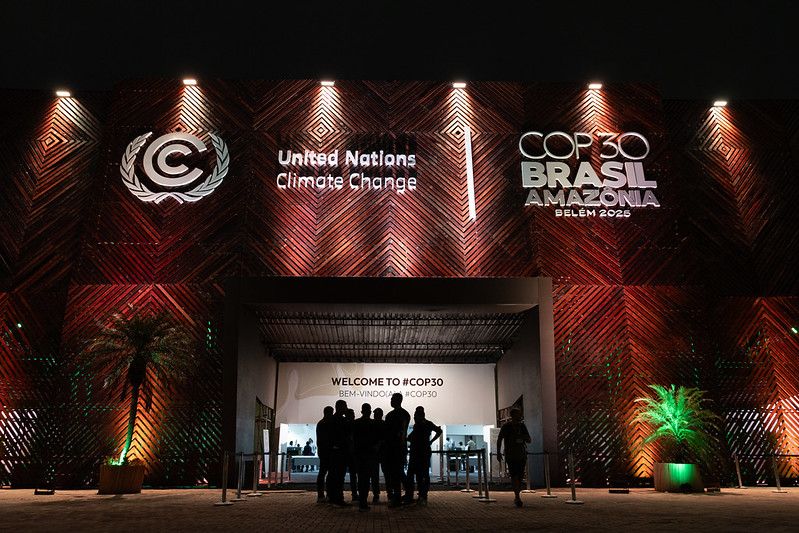
Wealthy countries have tripled their financial support to help vulnerable nations adapt to the impacts of climate change, but the final COP30 climate deal leaves out any mention of the fossil fuels that are driving it.
Counties failed to agree on a roadmap to transition away from fossil fuels, however, some countries are currently working on a voluntary plan outside the UN process.
The SMC asked experts to comment.
Dr Nathan Cooper, Associate Professor of Law, University of Waikato, comments:
“Despite failing to address deforestation or critical minerals, this deal represents some progress. It acknowledges the need for a ‘just transition’ to support vulnerable workers, it commits to make much more money available to developing countries for climate adaptation. But this is still incremental progress. What is really needed is a step change, a quick acceleration to phase down fossil fuels so that the pace of response to climate change starts to match the scale of the challenge.
“At the end of COP30, the multilateralism of the Paris Agreement remains just about intact. But there is still too little ambition for effective change, especially among rich nations and major fossil fuel producers.
“Meanwhile, countries including New Zealand continue to undermine effective action on climate change by setting Nationally Determined Contributions (emissions reduction commitments) that are not science-aligned and that, collectively, won’t achieve even close to the 1.5 degrees target, despite their legal commitment to do so.”
Conflict of interest statement: “No conflict of interest.”
Dr Priscila Besen, Senior Lecturer in Sustainable Architecture, Auckland University of Technology, comments:
“There were high expectations for this COP, with its setting in the Amazon, but the final text fell short of the ambitious promises that opened the summit. While it was encouraging to see adaptation receive greater attention — with COP30 adopting a call to triple adaptation finance by 2035 — the summit failed to directly confront the root causes of the climate crisis. There were expectations of a clearer roadmap to transition away from fossil fuels and end deforestation, yet these crucial elements were absent from the final text, due to disagreements among countries. Approximately 90 countries demonstrated their support for the roadmaps, and the presidency said they will still develop these post-COP, so there is still hope that this will be done later. The other bad news for Aotearoa New Zealand was that COP31’s host country will be Turkey, not Australia, as we were hoping.
“On a more positive note, I was pleased to see this COP make greater efforts to include diverse groups and boost civil society participation, with greater participation than in previous years. The overall outcome feels like a step back from what is urgently needed, but overall, it is still positive to see global collaboration in a year marked by many conflicts.”
Conflict of interest statement: “No conflict of interest relating to this statement.”
James Renwick, Professor of Climate Science & Physical Geography, Victoria University of Wellington, comments:
“No agreement has been reached to transition away from fossil fuels. In fact, fossil fuels are not even mentioned in the main report from COP30 in Belém, thanks to the oil-producing countries and the lobbyists from the oil industry. Moving away from fossil fuels is crucial to address climate change mitigation, and yes after 30 years of discussion, the global community cannot even mention this. This is a complete failure of global governance, and we will all, especially developing countries, suffer the consequences. So, good news that Belém has advanced action on adaptation to climate change, because we’ll need lots of that. There were a few other steps forward in policy around responding to climate change, but the core issue remains off the table. Pathetic!”
Conflict of interest statement: “I receive funding from the New Zealand government for climate research and know a number of policy analysts at government agencies who would have had input into our stance at COP30. However I do not feel I have any conflict of interest in commenting on the COP30 meeting.”
Dr Dalila Gharbaoui, Political and Social Scientist, Adjunct Research Fellow, University of Canterbury, comments:
“In the final hours of COP30, negotiations took a major step back when Brazil’s latest draft removed all fossil-fuel language, erasing earlier proposals for a transition beyond coal, oil, and gas. Climate-vulnerable nations pushed back immediately. Vanuatu’s climate minister criticized countries blocking any reference to fossil fuels, calling the stance a rejection of science and international obligations.
“As UNFCCC Executive Secretary Simon Stiell said, “COP30 showed that climate cooperation is alive and kicking”—but it is youth, Indigenous leaders, feminist groups, human rights advocates, and informal actors who have been “kicking” to be heard with a record number of demonstrations and contestations at the doorstep of the negotiations. Their call was loud and clear: to be heard as they lead some of the most transformative work yet remain underrepresented in COP decision-making spaces.
“I was encouraged by the widening focus on subnational climate finance. There is increasing acknowledgment that local governments deliver most climate action yet access only a fraction of climate finance. Some key numbers were shared during COP30 by the Sustainable Finance Observatory: the cities and regions account for around 70% of SDG implementation and 75% of global emissions, yet receive only 17% of international climate finance. The push for better financial engineering, stronger multi-level governance, and tools that turn local priorities into tangible outcomes felt like real progress.
“Still, negotiations fell short on predictable, scaled finance—especially for the most vulnerable states. Predictable climate finance and support for losses and damages remain far behind the scale of need.
“A key insight was the rising integration of circular economy principles into adaptation, reinforcing that regenerative systems are not just environmental but deeply social. Their success rests on collaboration and on the often-unseen leadership of women and other informal actors.
“My takeaway is clear: effective climate action depends on two things—respecting community rights and knowledge and ensuring finance flows to the local level where resilience is actually built. COP30 took steps in that direction, but the final text is a major setback. Expectations are high for COP31 in Turkey and for Australia’s leadership in government talks to restore ambition on transitioning away from fossil fuels and to deliver practical pathways for closing the local finance gap.”
Conflict of interest statement: “N/A”
Dr Cathrine Dyer, Lecturer in Climate Change, Victoria University of Wellington, comments:
“As the host of COP30, Brazil cast the summit as a ‘make or break moment’ for international cooperation on climate action.
“As the summit winds down with no formal agreement on a roadmap for phasing out fossil fuels, the response has been made clear. For the moment at least, international cooperation on climate action has been effectively neutered by petro-states supported by a widespread delusion that ‘business-as-usual’ can be sustained.
“In 30 years of international COP meetings, an agreement to reduce the use of coal, oil and gas has never been struck. It’s as if the world believes that climate change can be tackled by talking about it, while ignoring its primary causes.
“An energy transition requires that renewable energy replace fossil fuels. Without the broad application of policy constraints on the production and use of fossil fuels, additional cheap renewable energy risks becoming a catalyst for technological sprawl, igniting demand for more and more.
“The agreement reached at COP30 saw success in the adoption of a rights-based ‘Just Transition Mechanism’ and increased funding for Adaptation. While still critically under-funded, a specific focus on adaptation is necessary as climate funding typically focuses on more commercially attractive mitigation projects, where profit is available. No agreement on additional funding for loss and damage or a roadmap for delivering the new collective quantified goal (NCQG) on climate finance were achieved.
“In making space for community-based and indigenous knowledge, Brazil got one thing right. Now is the time to grow flourishing community conversations, connections, and grassroots action, following the lead of Indigenous people who refused to be sidelined at COP30. The transformations required to effectively address climate change are unlikely to emerge from established power.”
Conflict of interest statement: “I declare that I have no conflicts of interest to disclose.”
Professor Bronwyn Hayward, Professor of Political Science and International Relations, University of Canterbury, comments:
“New Zealand faces a stark choice: will we back a few large oil states who continue to block progress or will we support the Pacific and our traditional allies?
“At COP 30 New Zealand failed to join the call by the United Kingdom, Ireland, Pacific nations (including Fiji and Vanuatu), and over 83 other countries led by Colombia who pressed for a global plan to transition away from fossil fuels.
“Hard questions should be asked about why we found ourselves aligned by default with states like Saudi Arabia and Russia, who repeatedly veto attempts at collective climate progress?
“Calls are mounting for reform of the COP process, which currently enables a single individual country to veto collective decisions. One of these reforms might already be found in the compromise that was achieved over who hosts the next COP meeting.
“The Republic of Türkiye’s had insisted it should chair the next COP, despite reportedly not having the support of most nations. The stalemate was broken with an agreement that Türkiye would be the host nation but the lead negotiator would come from Australia (Chris Bowen) with a pre-COP meeting hosted by the Pacific.
“The Pacific small island states have been masterful in keeping a focus on the impact of 1.5 degrees of warming and it will be important that New Zealand supports the Pacific to use this new arrangement in effective ways to press their case.
“Meanwhile, agreement to finance adaptation and recognise indicators of effective adaptation was achieved at this COP but only within current budget plans. Given the billions of dollars that a single major storm event can already cost a country, adaptation progress is despairing slow
“And yet, ‘We are still here’ as Brazil’s Environment & Climate Minister Marina Silva said in her closing words at COP today. She is well placed to reflect on the importance of diplomatic and civil society struggles to achieve international agreements since Brazil’s first global Earth Summit in Rio De Janeiro back in 1992. Her life experiences as a deforestation activist, union worker and politician have symbolised the high hopes some had for a Brazil COP presidency.
“While the power bloc of the oil states, unchecked by the USA and/or China, has slowed global progress, for New Zealand the choice is more stark: will we back the Pacific and press for real progress or join a few nations who continue to block practical and meaningful climate action?
“While the cost of living is a real and immediate problem for many nations, more and more governments are realising that if they fail to act to protect their communities from the costs and loss of life involved climate disasters they will also be judged very harshly by voters.”
Conflict of interest statement: “Prof Bronwyn Hayward is a Professor of Political Science and International Relations at UC, and was a co convenor of Adaptation Futures 2025. She is a Review Editor for the forthcoming IPCC Special Report on Cities and Infrastructure and has served in a variety of roles in the last round of IPCC reports. No conflicts.”