The Science Media Centre is New Zealand’s trusted, independent source of information for the media on all issues related to research, science, and innovation.
With over 15 years of experience working on the front lines of breaking news, research, science and technology, the Science Media Centre is uniquely placed to provide insights on the ways controversial issues emerge and evolve in the public arena.
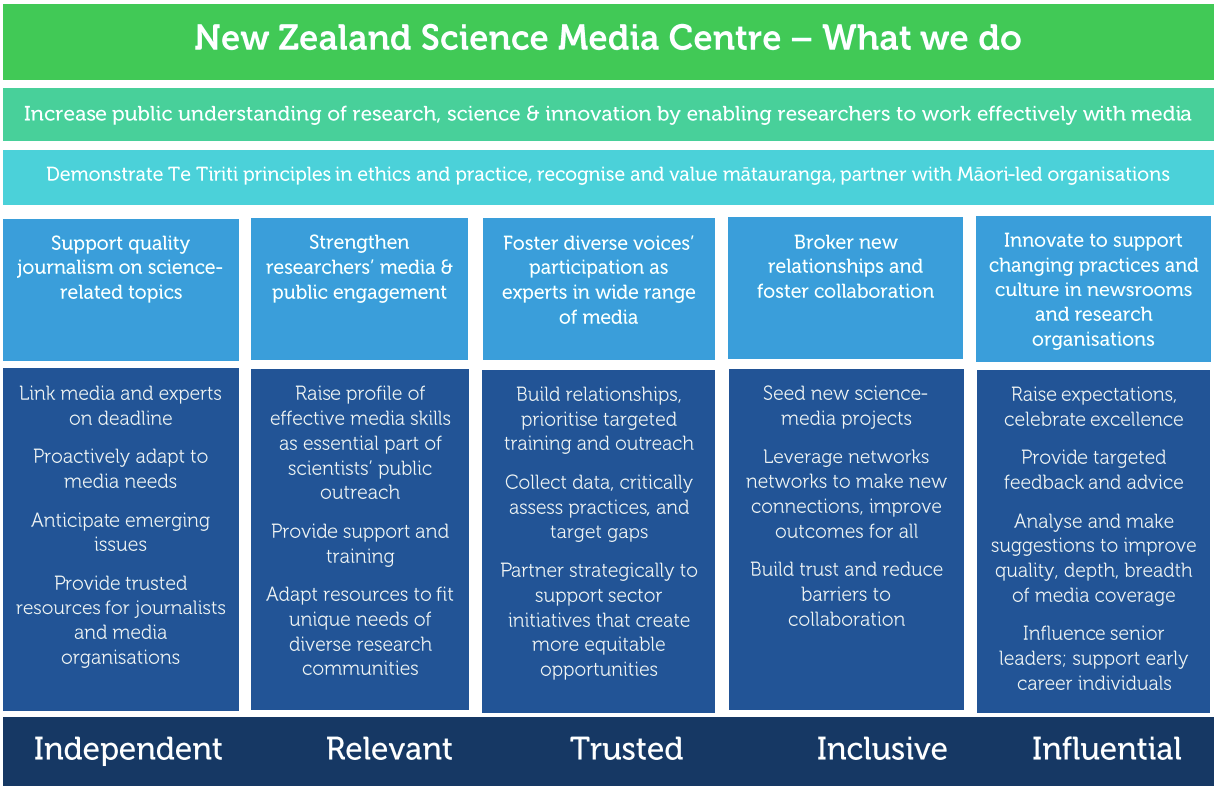
View the Science Media Centre Strategic Plan 2023-25
Tens of thousands of news stories providing context from and quoting New Zealand researchers result from our work, everything from national television news, radio bulletins and feature-length magazine articles to data journalism, in-depth explainers and podcasts.
The issues we cover are wide-ranging, including climate change and environmental crises, earthquakes, cyclones and other natural hazards, infectious disease and biosecurity outbreaks, water quality and food safety, social issues and emerging technologies. Better informed, high quality media coverage results from our input as we work tirelessly behind the scenes to hep newsrooms navigate misinformation and dubious claims. We also help researchers become more confident in their dealings with the media through Science Media Savvy workshops.
We have established a great base for increased collaboration and input from New Zealand researchers to help the media better address the big science-related issues facing the country.
The Science Media Centre is funded by the Ministry of Business, Innovation and Employment (MBIE) as part of the National Strategic Plan for Science in Society – ‘A Nation of Curious Minds‘.
History of the Science Media Centre
The SMC was conceptualised on the success of the Science Media Centres in the UK and Australia, which provide proactive and timely links between the expertise of their research communities and national news media. Around the world, there is a growing international network of independent science media centres.
As part of the strategy to engage New Zealanders with science and technology, in its 2007-2010 Statement of Intent, the Ministry of Research, Science & Technology (now the Ministry of Business, Innovation and Employment) announced a three-year pilot Science & Technology Media Centre for New Zealand.
Following an open call for expressions of interest, the Royal Society Te Apārangi was awarded the bid to develop and operate the Science Media Centre. A consultation with media, the research community and other stakeholders identified initial priorities and activities for the centre.
The New Zealand Science Media Centre was launched to the media on 30 June 2008 and officially opened on 1 July 2008.
From 2008-2015, the SMC drew on the experience of a Science Advisory Panel to provide advice when needed. Since then, we have invited researchers to serve on our advisory group alongside media representatives.
In 2013, we piloted the first Science Media Savvy workshop for researchers with seed funding from Prime Minister’s Science Media Prize winner Dr Mark Quigley. Over more than a decade, this influential programme has trained thousands of New Zealand researchers in advanced communication skills and expanded their strategic understanding of the media.
Under the 2014 National Strategic Plan for Science in Society, A Nation of Curious Minds – He Whenua Hihiri i te Mahara, funding for the NZ Science Media Centre was extended. This enabled our contribution to the launch and ongoing support for the Science Media Exchange (Scimex.org), which we operate in partnership with the Australian Science Media Centre.
A comprehensive independent review of the NZ SMC was carried out in late 2020, finding that:
- the SMC is contributing to improved quality, breadth, and depth of science reporting
- the SMC delivers a range of services that are efficient and user-focused and have good uptake
- trust and confidence in the SMC are high
- looking forward there continues to be a need for the SMC.
The evaluation concluded that SMC meets its objectives well and delivers value for New Zealand. The full evaluation report, including excerpts from interviewees, is available here.
In 2021 there was open call for proposals to host the NZ SMC for another five years (1 July 2022 – 30 June 2027). The successful applicant was the incumbent host, the Royal Society Te Apārangi.
The Terms of Reference for the NZ SMC were revised and updated in 2022.