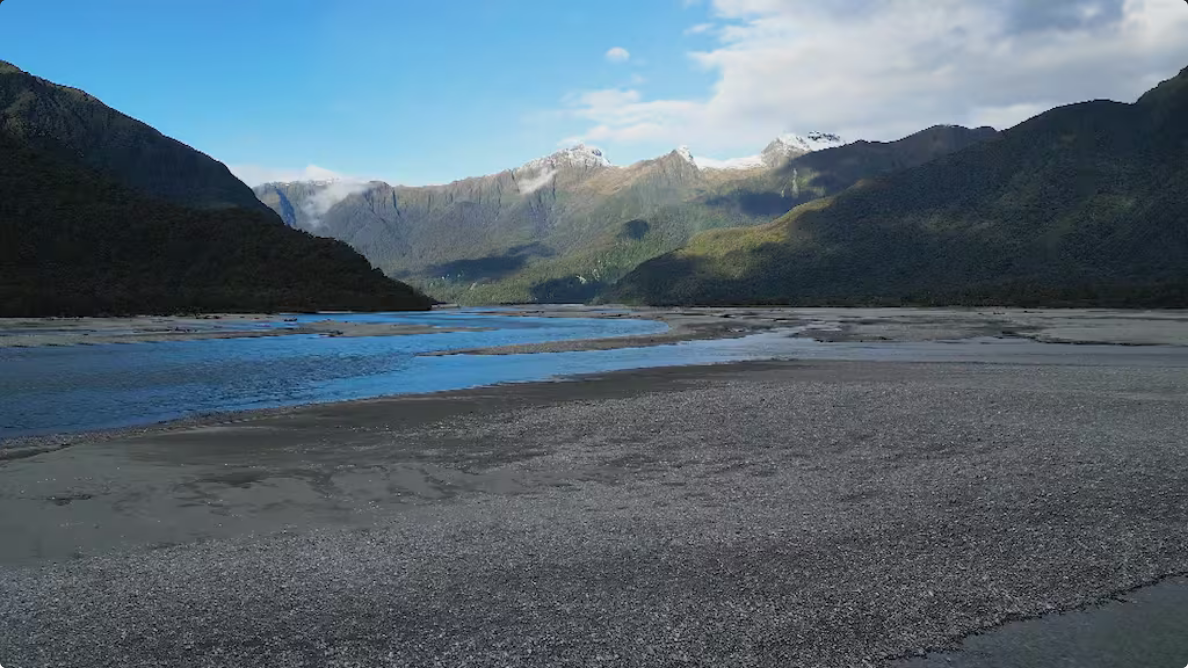
Researchers have used a fibre optic cable along Haast Pass to find out what’s going on in the South Island’s major fault.
They fired lasers down an unused fibre and measured it stretching when earthquake waves passed through it.
The data revealed the structure of the Alpine Fault in higher resolution than ordinary seismometers, helping them understand how it might behave in a big earthquake.
The SMC asked the NZ author and other experts to comment.
John Townend, Professor of Geophysics, Victoria University of Wellington, and an author of this paper, comments:
“We’ve used an ordinary telecommunications cable to look inside one of New Zealand’s most significant faults.
“By sending laser light down an optical fibre in a cable crossing the Alpine Fault near Haast, we turned it into a long line of sensitive earthquake sensors. Seismic waves from small earthquakes nearby travelled along the fault as distinctive energy pulses that reveal its internal structure.
“The signals show the fault isn’t a single clean crack. It’s a band of damaged rock about 200 metres wide, roughly two rugby fields. Within it, we found six much narrower zones of more intensely crushed and sheared rock. We call these “cores,” and we think the most prominent core is where the fault slipped during recent large earthquakes.
“This main core runs for about 180 kilometres. At the surface, the fault bends and kinks, but underneath, its main slip zone appears to be largely continuous.
“This matters because an earthquake’s size depends mainly on how much of the fault breaks.
“Understanding the fault’s structure helps us work out how much could break at once, and so how large the next big earthquake might be. That helps Aotearoa prepare for the hazard and reduce its impacts.”
Conflict of interest statement: Professor Townend is an author of this paper.
Research Professor Caroline Orchiston, Director, Centre for Sustainability Research, University of Otago, comments:
“Alpine Fault science is taking another leap forward with new research using Distributed Acoustic Sensing, or DAS from a fibre optic cable positioned across the fault near Haast.
“Using the exciting new acoustic sensing approach, the study reveals incredible detail about how complex the fault zone is near the surface, and what this could mean for magnitude, ground motions and aftershocks.
“It also confirms that the boundaries between fault segments (i.e. the South Westland, Central and North Westland segments) act as a barrier to the way earthquakes move across the fault, with larger magnitude events (magnitude 8+) more likely to jump segment boundaries.
“All together, this new science can really help us understand what a future Alpine Fault earthquake could be like, e.g. do most large earthquakes on the fault turn into magnitude 8+ events, or could we expect some in the magnitude 7 range that stay within one segment of the fault? And what does this new knowledge mean for how we might forecast aftershocks one day? These are all questions for the future, but we need this fundamental research to help us get there.
“And it is still early days for DAS as a technique – with more research funding it will be possible to advance our knowledge much further.
“This research also highlights that Alpine Fault science is leading the world towards a better understanding of mature plate boundary faults (ones that have produced many earthquakes over thousands or millions of years). Scientific research like this has important implications for the people, communities and infrastructure exposed to seismic risks. The more we know about the Alpine Fault and how it behaves, the more we can do to reduce risk and improve our readiness for the next event.”
Conflict of interest statement: “Caroline was the Science Lead for AF8 until 2024.”
Dr Emily Warren-Smith, Seismologist – Earth Sciences New Zealand, comments:
“While much of the Alpine Fault is inaccessible and sparsely populated, like in South Westland, these often-forgotten remote sections are actually hugely influential in determining what the next earthquake will look and feel like.
“How an earthquake rupture navigates the Haast stretch of fault, in particular, has been shown to be the difference between a devastating event with impacts felt nationwide, and a much smaller lower-South Island limited earthquake.
“DAS now offers an incredibly detailed way of studying these complex and remote sections of faults to unparalleled scales, all while using existing infrastructure.
“These detailed observations are vital in helping us build better earthquake models to help prepare for the next Alpine Fault earthquake.”
Conflict of interest statement: “Dr Warren-Smith is conducting research on the structure of the Alpine Fault, including in collaboration with one of the authors of this study, but was not involved in the paper.”