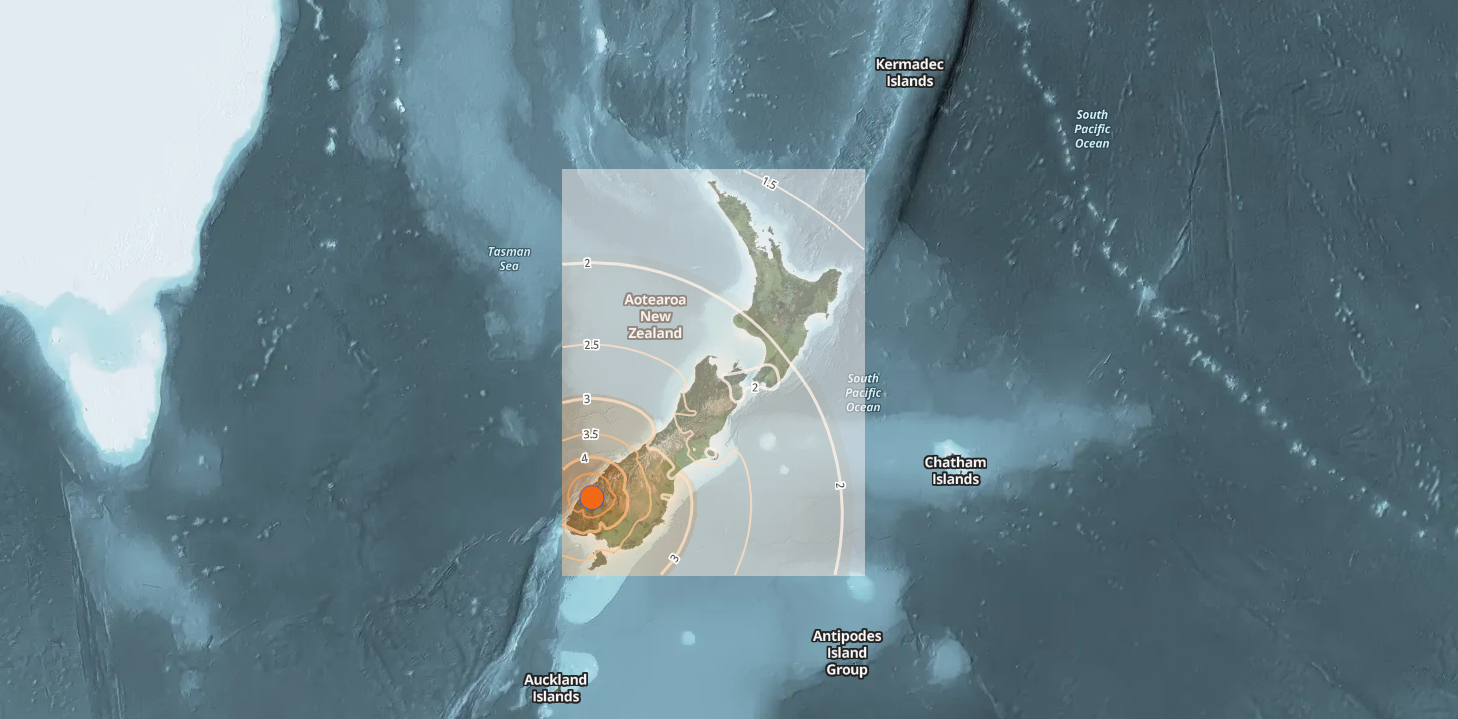
A strong earthquake last night near Te Anau was followed by a tsunami warning and aftershocks.
The tsunami warning, issued for Milford Sound to Puysegur Point, was downgraded then cancelled after an early estimate of the earthquake magnitude was revised down.
Small aftershocks continued overnight.
The SMC asked experts to comment.
Lucy Kaiser (Kāi Tahu, Kāti Māmoe, Waitaha) Senior Māori Social Scientist for Hazard & Risk at ESNZ and Massey University, comments:
“I want to first acknowledge what communities went through: an evacuation warning on a cold winter night, with limited information and little time to act. I also acknowledge the people involved in the warning decisions, working under intense time pressure with an evolving picture. Both experiences deserve recognition in how we review this event.
“Last night’s earthquake was a reminder that we need to be prepared for strong shaking in the takiwā and able to respond or evacuate if there is risk of a tsunami. As well as the Alpine Fault, the Fiordland-Puysegur subduction zone (which sits within and below the Southwest of Te Waipounamu), is a potential source for earthquakes and tsunami. We still know relatively little about this subduction zone, how often it produces large earthquakes, or how big the resulting tsunami could be.
“What we do hold is knowledge from our own histories. Accounts of a tsunami that claimed the lives of a number of Kāti Māmoe on the beach near Orepuki in the 1820s remain among the few records of what this part of the plate boundary can do. Scientific modelling suggests it may be capable of a magnitude 8.5 earthquake generating four-metre waves along the Southland coast. Very little is known about how often these events occur and how far the impacts will spread. Mātauranga Māori, alongside modelling and other forms of exploratory tsunami research, are all part of how we close that knowledge gap.
“In the meantime, the safety message stands: near this coast, the earthquake itself is the warning. If it is long or strong, get gone.”
Conflict of interest statement: “No conflicts of interest to declare.”
Dr Lauren Vinnell, Senior Lecturer of Emergency Management, Joint Centre for Disaster Research, Massey University, comments:
“Firstly, I hope everyone down south is alright after a shaky night. Earthquakes can be unsettling at the best of times, but that one was fairly big and has had a few aftershocks. The advice remains to ‘drop, cover, and hold’ if you do feel more earthquake shaking, in case it is a bigger one.
“For those who evacuated, either because of the notice or because they felt long or strong shaking, you did the right thing. It’s great that it wasn’t as bad as it could have been, but tsunami are really dangerous if you’re caught in them and when it comes to lives it’s definitely better to err on the side of caution. It seems like in this case our national agencies acted quickly and struck a good balance between speed and certainty.”
Conflict of interest statement: “No conflicts of interest.”
Dr Ulrich Speidel, Senior Lecturer in Computer Science, University of Auckland, comments:
“Questions are being asked after last night’s quake and tsunami alert in Southland where the civil defence website buckled under traffic load.
“I have been leading an international consortium of researchers for the past year to find out what critical Internet services (not just Civil Defence websites, but these, too) we might lose access to in an on- or offshore disaster as NZ’s Internet connectivity could be affected by Hunga Tonga Hunga Ha’apai-like events or quakes in places as far away as Tonga, Hawaii or the US West Coast.
“One of the early insights of our study is that usability of Internet resources in a disaster does not appear to be a major design goal. NZ’s civil defence websites are a case in point.
“For example, I just tried to find my local Civil Defence centre from the national civil defence website as the starting point. It took me eight clicks – and some educated guessing as to what to click on – to get to a slow-loading map on a different website that finally told me where I’d evacuate to.
“But that assumes that I will be able to access these websites at all. The national website appears to be hosted in the Auckland area, but the Auckland Civil Defence Emergency Management (CDEM) Group website that holds the page with the map currently appears to be hosted on a server in Australia, with the slow-loading map itself coming from an Auckland server at the moment.
“Including material from multiple web servers on a single website is an incredibly common practice, but one that can backfire in this sort of situation if one of the servers is affected and the entire site breaks.
“Secondly, the slow load of the map indicates that this is a prime candidate for buckling under load. If it takes the best part of 10 seconds for me to load this on a gigabit fibre connection when I am perhaps one of only a handful of users at the time, how will this work when thousands of my fellow Aucklanders will be looking this information up at the same time as me?”
Conflict of interest statement: Dr Speidel is researching loss of critical Internet services in disasters as part of a consortium from NZ, Japan, Germany, the Netherlands and the US, supported by a Royal Society of NZ Catalyst Seeding grant.