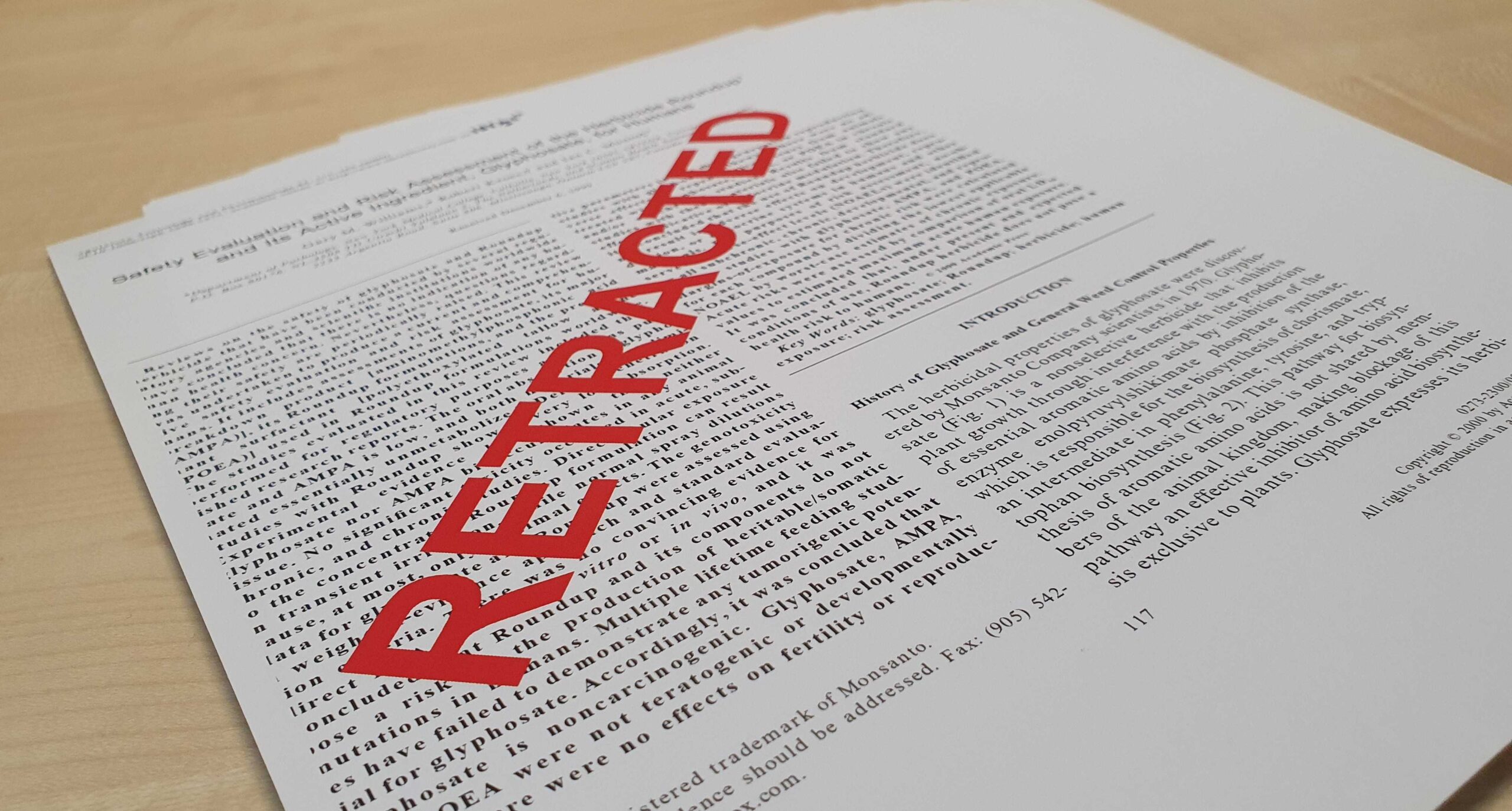
A peer-reviewed article on the safety of the herbicide glyphosate has been retracted, eight years after ghostwriting from Monsanto employees was revealed in court.
A New Zealand-based scientist formally requested the retraction. He comments below, alongside pesticide experts who comment on the overall state of the evidence.
Dr Sasha (Alexander) Kaurov, PhD Candidate in Science and Society, Victoria University of Wellington, comments:
Note: Dr Kaurov requested the ghost-written paper be retracted. He is the author of research into how the study influenced the glyphosate safety discourse.
“Glyphosate is the world’s most widely used weed killer. A 2000 review article, long treated as an independent, authoritative summary of glyphosate’s safety, has just been retracted for serious ethical breaches. Internal documents revealed in a 2017 litigation show the article was substantially ghostwritten by Monsanto (now Bayer), the manufacturer of glyphosate, while company employees were left off the author list. That means regulatory decisions worldwide were being guided by what looked like neutral science but was, in fact, corporate advocacy.
“In our recent study, I and professor Naomi Oreskes (Harvard University), traced how this article shaped debates about glyphosate over the past 25 years. We found it widely cited in scientific papers, on Wikipedia pages that people use to understand glyphosate risks, and in official reviews around the world. That includes Health New Zealand’s “The Investigation and Surveillance of Agrichemical Drift Exposures: Guidelines for Public Health Officers”, published in 2024, in which this 2000 review is used to support the statement of glyphosate’s low acute toxicity. It is seven years after the review was revealed to be ghostwritten.
“In July 2025, we formally requested the retraction of the paper. It was concerning that we were the first to do so, despite the paper’s influence and the years that had passed since the ghostwriting was revealed. We appreciate that our retraction request was supported by the current editor-in-chief of the journal that published the review. The retraction is an important step, as it sets a precedent that even quite old papers can be reevaluated for ethical concerns. Yet this whole situation shows how vulnerable regulatory efforts worldwide are to this kind of corporate influence through scientific fraud. Moreover, this is just one of many compromised reviews. For example, the successor of this 2000 review, a 2013 review by Kier and Kirkland, also shown by Le Monde to be ghostwritten by Monsanto, is still not retracted.”
Conflict of interest statement: “I declare that I have no financial interests in agriculture, pesticides, or related industries. This work was supported by the Rockefeller Family Fund under a grant led by Principal Investigator Professor Naomi Oreskes.”
Professor Melanie Kah, School of Environment, University of Auckland, comments:
“There are hundreds of experimental studies on the toxicity of glyphosate, and regulators do a very detailed work before they come to a decision. A few months ago, the NZ High Court upheld the Environmental Protection Authority’s (EPA) decision not to reassess glyphosate, because of the lack of significant new information (mainly related to its carcinogenicity). The 25 year-old review that was recently retracted would not contribute new information and its impact on current decisions is thus likely minimal.
“I’m not defending the current overuse of glyphosate (in an ideal world we wouldn’t be as dependent on the use of pesticides to grow our food) but I think there is a scientific consensus that glyphosate is less toxic than many of the other agricultural compounds currently in use. Phasing out glyphosate would result in other herbicides being used instead, which would probably have more impact on human and environmental health. This context is often forgotten when discussing glyphosate.
“That said, funding/authorship by industry/NGO can naturally lead to publications that serve their interests (or the lack of publication if results go against their interests). I am glad this study was retracted and I agree conflicts of interest should be scrutinised and fully declared.”
Conflict of interest statement: “My CoI is limited to my motivation to publish papers that will attract attention/citations/grants.”
Professor Ian Shaw, Professor of Toxicology, University of Canterbury, comments:
“Retraction of a scientific paper is rare. In the rare event that it is necessary, it is usually requested by the authors because they have found an error in their work. It is exceptionally unusual for the editors of a journal to retract a paper on conflict-of-interest grounds.
“The current retracted paper presented what appears to be a well written and authoritative review of the literature on glyphosate’s toxicity, including carcinogenicity. The paper’s conclusion was that glyphosate is not a carcinogen and so does not present a hazard to exposed humans. This flies in the face of the International Association for Research on Cancer (IARC)’s rating of glyphosate as Carcinogen 2A (possibly carcinogenic to humans). This usually means that there are animal data in support of carcinogenesis, but there are few human epidemiological data or that they are inconclusive.
“I am always concerned when anyone says or writes that there is no risk. There is always risk, but it might be low or even negligible. The authors of the retracted paper end the abstract to their paper: ‘Roundup herbicide does not pose a health risk to humans’. This very definite risk statement, I presume, becomes a concern if the authors are working with or aligned to Monsanto.
“Dr Wayne Templeton in his 2016 review of glyphosate for the NZEPA came to a similar conclusion. His review was (in part) in answer to the IARC’s glyphosate carcinogenicity rating. Dr Templeton, like the authors of the retracted paper, missed the possibility of non-genotoxic carcinogenesis as glyphosate’s mechanism of carcinogenesis – both works focused on chemical modification (mutations) of DNA not other (e.g., hormone-like) mechanisms that do not involve mutations.
“Templeton references the retracted paper in his work. This means that the retracted work influenced Templeton’s ‘non-carcinogenic’ finding.
“I have reviewed the glyphosate literature (in a far less comprehensive review and in a far less prestigious journal: Is it time to round up roundup?) and concluded (in part) that glyphosate is a likely human carcinogen, but that the dose consumers might receive from residues in food is negligible in a carcinogenicity context, but that agricultural workers’ exposure is a significantly greater risk.
“The retracted review has been read by many scientists over 25-years and cited in 1,311 scientific papers. It is likely that the evidence and views presented in the retracted paper have had a significant influence on decisions made about glyphosate’s risk to humans.
“The paper was retracted on conflict-of-interest grounds, not grounds of scientific error or misinterpretation. The data in the paper should be reviewed and represented in a non-biased manner. Only after this can we be certain that the authors of the retracted paper were right or wrong in their interpretation of a huge amount of scientific literature.”
Conflict of interest statement: “I authored a review on Roundup, which presents a different viewpoint to the authors of the retracted paper.”
Professor John D. Potter, Centre for Public Health Research, Massey University, comments:
Note: Professor Potter was an author of a related NZ Medical Journal Viewpoint on the cancer risks of glyphosate, which also refers to the issue of ghostwriting.
“Glyphosate is the most widely used pesticide in the world and is found in a lot of food. I am pleased to see the retraction because the information available in that paper is ghostwritten and inappropriate. The use of glyphosate needs further restriction.”
Conflict of interest statement: “No conflicts of interest.”
Professor Oliver Jones, Professor of Chemistry, RMIT University, Melbourne, Australia, comments:
“While this story will no doubt be seen as evidence of industry wrongdoing, it really needs to be viewed in the context of the broader evidence base on glyphosate.
“Bayer and Monsanto may not be perfect corporate citizens, and ambiguity of authorship is certainly not a great look, but neither of these automatically means the results are actually wrong. Even if everything alleged is true, the retraction of one paper in no way affects the many other papers, government reviews, and even legal cases over the last 30 years that show glyphosate is safe at the doses we are exposed to. Believe it or not, scientists and regulators do not base their decisions entirely on one paper; they take a weight-of-evidence approach before deciding.
“It is often claimed that glyphosate causes non-Hodgkin lymphoma, but this is not a single disease but a catch-all term for approximately 60 different blood cancers that are quite different from each other. It is a little like classifying all voters as Labour voters or non-Labour voters. It is technically correct but misses essential context.
“Much of the safety data on glyphosate is in regulatory submissions as part of the approval process rather than in the scientific literature, but this does not make it any less valid. There have been extensive reviews by regulatory agencies worldwide on this issue, including those of the US, Canada, Japan, Germany, and the European Union, which have all reached the same conclusion. If we think about it, why would regulators approve something they thought was harmful? They, their families, and their friends would be exposed to it as well.
“In short, while clearly disappointing, the retraction of one paper is not the whole glyphosate story.”