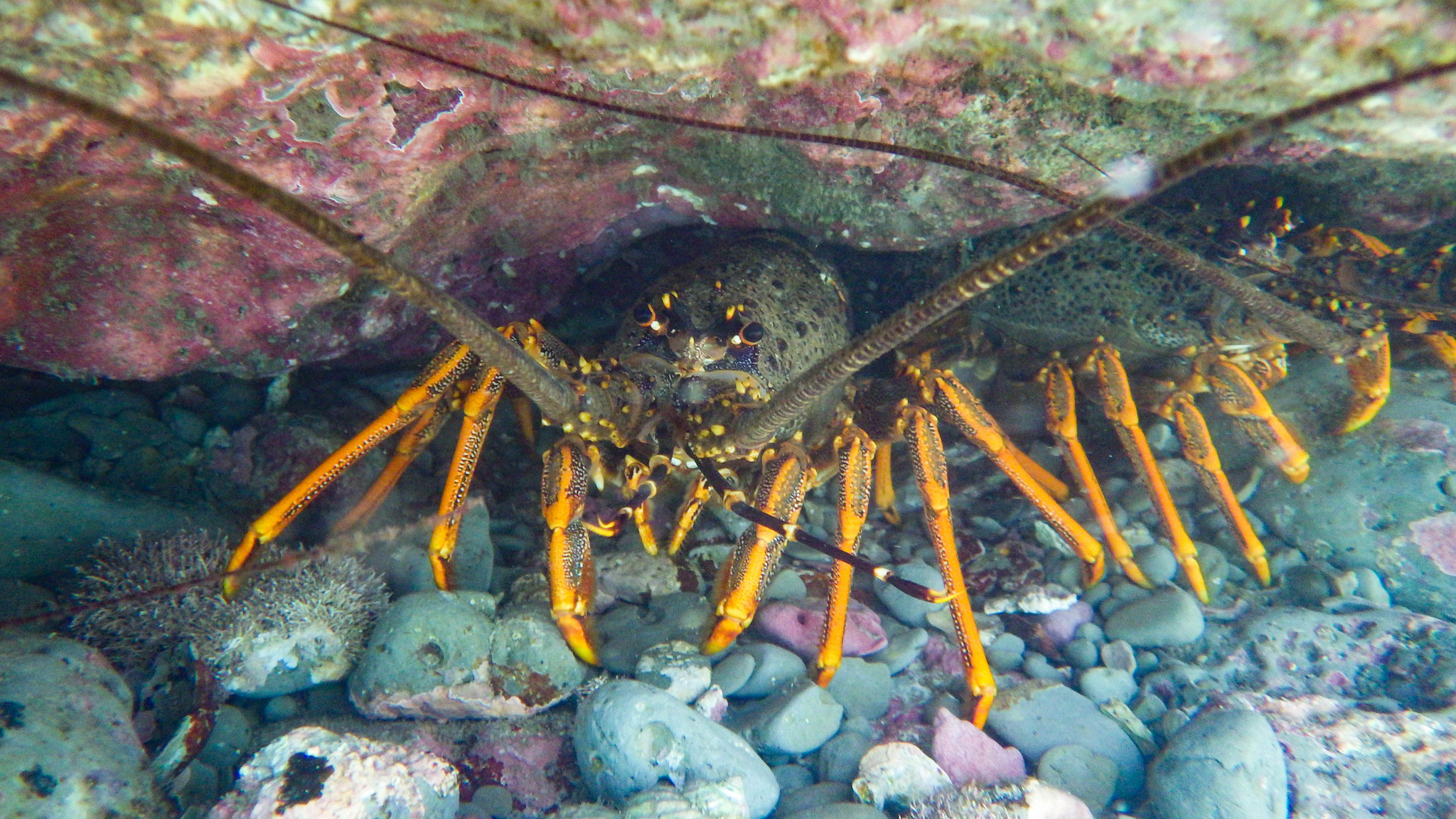
Recreational and commercial kōura fishing could be banned on Northland’s east coast to help prevent kelp forests turning into sea urchin barrens.
Rock lobsters (better known as kōura and crayfish) are a natural predator of sea urchins, which can overgraze the kelp, leading to barren rocky reefs.
A three year closure on rock lobster fishing was introduced for the Inner Hauraki Gulf in April 2025.
The SMC asked experts to comment on the situation in Northland, and the relationship between kōura, kelp forests, and urchin barrens.
Dr Benn Hanns, Research Fellow in Marine Science, University of Auckland, comments:
“Kōura (crayfish, Jasus edwardsii) populations on Northland’s east coast are heavily overfished, ecologically degraded and failing to support healthy kelp forest ecosystems through their role as key sea urchin predators. This decision is an important step towards holistic ecosystem-based management to tackle the loss of kelp forests due to unrestricted grazing by kina, or the range-expanding long spined sea urchin.
“If the goal is to restore and rebuild Kōura populations on Northland’s east coast, past research has shown that restricting all fishing, recreational and commercial, is essential. Aside from fishing pressure, Northland’s east coast Kōura populations are also being impacted by ocean warming. Spiny lobster such as Kōura spend a considerable amount of their early life far out at sea as larval plankton before reaching rocky reef habitat and taking their final adult form. The likelihood Kōura larvae eventually find and settle on appropriate rocky reef habitat is therefore heavily influenced by environmental conditions. Recent research is suggesting increasing sea surface temperatures are correlated with lower levels of larval settlement on rocky reef habitat in north-eastern New Zealand.
“Past work looking at recovery of Kōura in Aotearoa’s marine reserves has shown us that rates of recovery are closely connected to rates of larval settlement, with recovery under low settlement conditions potentially taking decades. It is therefore vital this decision is not just a flash in the pan closure, but set in place for a suitable period of time to allow Kōura populations effectively rebuild.”
Conflict of interest statement: “No conflict of interest.”
Dr Christopher Cornwall, Senior Lecturer in Marine Biology, School of Biological Sciences, Victoria University of Wellington, comments:
“We know from scientific evidence that if we take all of the predators of sea urchins out of the kelp forest then the number of sea urchins will increase in areas where different urchin species can live. For kina (Evechinus chloroticus), they can mostly live throughout NZ but are slightly more abundant in the north and in moderate to low exposure sites. For Australian Long Spined urchins (Centrostephanus rodgersii), this is mostly in the warmer areas around northern NZ.
“Once sea urchin numbers (or biomass) increase beyond a critical point, these kelp forest systems turn into sea urchin barrens.
“The primary sea urchin predators are snapper and eastern rock lobster, though other invertebrates and finfish can predate on smaller urchins. A series of experimental work here in NZ and overseas demonstrates this link between predator numbers and kelp forest collapse very clearly. This is occurring in northern New Zealand, Marlborough Sounds, and Wellington’s Harbour to my knowledge, but could be occurring in other regions too. If predator numbers are high, the kelp forest can regenerate, and the formation of barrens can usually be halted.
“We also know if we remove or relocate kina, barrens that have formed can regenerate back into kelp forests in most instances. However, this is a short-term solution, as it requires almost complete removal of kina due to the nature of the relationship between kina numbers and kelp. That is, small numbers of kina can continue to eat all the kelp being added into the system, so almost all kina need to be removed to restore a kelp forest. Whereas to create the barrens, more kina need to be in the system to tip it, as they can eat kelp that drifts in rather than kelp growing in the forest, to some extent.
“Also, the mere presence of predators could change kina behaviours, causing them to live within crevices and feed on this drift kelp instead of going into the open to consume live kelp. Secondly, we would need to remove kina periodically in order to maintain the kelp forest state.
“Regarding climate change, the main issue for Northland will be the spread of Long Spined urchins and their ability to form more extensive barrens than kina (though kina barrens are also pretty bad). Their larvae survive better in warmer waters, and with ocean warming, it is likely making it easier to spread into more areas of New Zealand. There are anecdotal reports it is already further south than Gisborne, but I have not dived extensively on that coast and haven’t seen any there myself.”
Conflict of interest statement: “Dr Cornwall is a co-director of Te Herenga Waka Victoria University of Wellington’s Centre for Biodiversity and Restoration Ecology as well as an Associate Director of the Tertiary Education Commission funded Centre of Research Excellence Coastal People Southern Skies.”