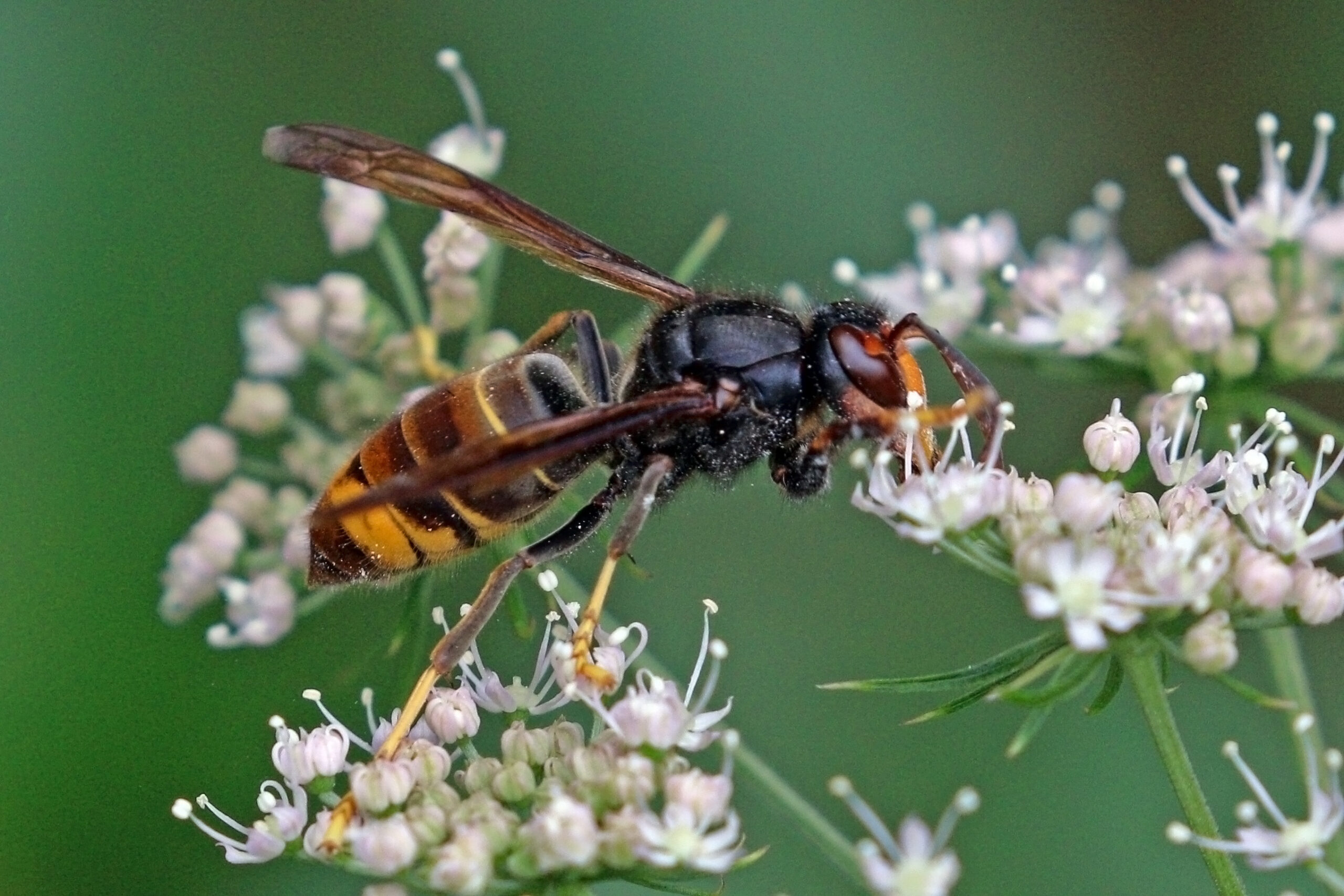
Efforts to track down the yellow-legged hornet have ramped up this week, with queen hornets and nests continuing to be detected in Auckland’s North Shore.
Yellow-legged hornets (Vespa velutina) are a non-native pest. Biosecurity New Zealand wants to hear from anyone who has a suspected hornet specimen, has located a possible nest, or has taken a clear photo.
The SMC asked experts to comment on the current situation and provide background information.
Phil Lester, Professor of Ecology and Entomology, Victoria University of Wellington, comments:
Note: Professor Lester has recently written two pieces for the Conversation on this issue, available here (4 November) and here (1 December).
“More queen hornets have been found in the last few days, and 20 of the 31 show evidence of active nests. These discoveries sound a serious warning. Overseas experience shows that once established, these hornets spread quickly, attack honey bees heavily, endanger people, and can cause major economic damage.
“MPI is working hard and have increased their trapping and search effort, which is commendable and a positive step. They are now using a 5 km radius from detection sites, with property-by-property searches underway within 200 m of each confirmed find.
“It is difficult to accurately predict how far hornet queens might have flown. One of the best estimates comes from the hornet’s invasion of Italy, where researchers found that 95% of nests in one year were within 6 km of those found the previous year. However, to eradicate hornets in New Zealand, we need to find every last queen. The Italian study suggests that to capture 100% of potential nests, the search radius would need to be expanded to at least 11 km from the known Auckland detections.
“The hornet queens might have dispersed much further if they landed on trucks or other transport out of the Auckland region.
“We must determine exactly how far, and in which directions, the queens have dispersed. Expanding the search intensity and radius even further would be a sensible and necessary step.
“Yellow-legged hornet eradication is achievable — as demonstrated in Majorca — especially with New Zealand’s additional advantage of the Vespex baiting system. But success depends on acting now: intensifying searches, accurately mapping the infestation, and destroying nests before they produce new queens in autumn.
“The next few months could decide whether this hornet is eradicated or becomes a permanent problem.”
Conflict of interest statement: “I’m a member of the Technical Advisory Group for MPI on the yellow-legged hornet incursion.”
Dr. Jenny Jandt, Senior Lecturer, Department of Zoology, University of Otago, comments:
What threat(s) does the yellow-legged hornet pose to humans and/or New Zealand’s ecosystems?
“The two threats we know of with some certainty are threats to honeybee colonies and threats to human health.
“Yellow-legged hornets (Vespa velutina) will hunt and kill honeybees, ultimately leading to the death of the whole colony. As you can imagine, honeybee keepers are particularly concerned.
“My colleague from Spain (Xesús Feás) has been studying yellow-legged hornets for years. When I reached out to him about this on 12 November, he said (as a point of reference) that in Galicia (north-west Spain), three people had died in the past ten days following stings from yellow-legged hornets. He said this underlines how quickly the species can become a serious problem not only for beekeeping but also for public safety.”
What’s at stake if we don’t achieve eradication?
“My biggest concern is the potential for yellow-legged hornets to spread (in general), but also for them to displace and become established in the beech forests. The beech forests of New Zealand are home to the highest density of ground-nesting wasps in the world. While there are a number of ecological factors and tourism are being significantly affected by this, scientists have started finding ways to reduce their impact or possibly eradicate them completely. It’s not clear whether the tools we have developed for common and German wasps will be effective against yellow-legged hornets.
“While most people would consider common and German wasps dangerous, I find them almost pleasant to work with (NB: I know my body can handle being stung a few times). However, I would need to invest in a lot more gear if I were to head out to work with yellow-legged hornets (I would probably need to import gear from overseas), especially given that their stings can be fatal.
“If yellow-legged hornet populations are allowed to expand in a similar way to common and German wasps, the ecological damage is impossible to predict.”
How can the public tell the difference between yellow-legged hornets and other insects, like bees or other wasps?
“Yellow-legged hornets are black and yellow striped, brightly coloured similar to our ground-nesting common and German wasps, and Polistes paper wasps. However, yellow-legged hornets are a lot bigger (workers – 20-30mm, queens 35mm compared to common and German wasp workers – 12-17mm, queens 20mm). This time of year, people might see ‘big wasps’ and think they might be yellow-legged hornets, but they could also be queen common and German wasps. Both are dangerous.
“The best advice I have is for folks to take a photo and upload it to iNaturalist.nz. Even a slightly blurry photo or one from far away will quickly be identified by someone on iNaturalist. MPI regularly checks observations submitted to iNaturalist too. It’s the safest way to handle this and to contribute to the eradication effort.
“If the wasp is on a flower or distracted with food, a person can try to get closer to take a photo. If the wasp is flying in and out of a hole, stay away. That’s probably the nest, and very dangerous to get close to.
“iNaturalist.nz is a great citizen science platform that allows folks of all ages and expertise an opportunity to ID plants, animals, insects, fungi etc. There are a lot of rare, native organisms that need our protection, and a lot of unwanted organisms besides the yellow-legged hornet that scientists are trying to track and eradicate. By posting your observations on iNaturalist.nz, you might be aiding the efforts to protect the beautiful flora and fauna of Aotearoa.”
Conflict of interest statement: “None.”