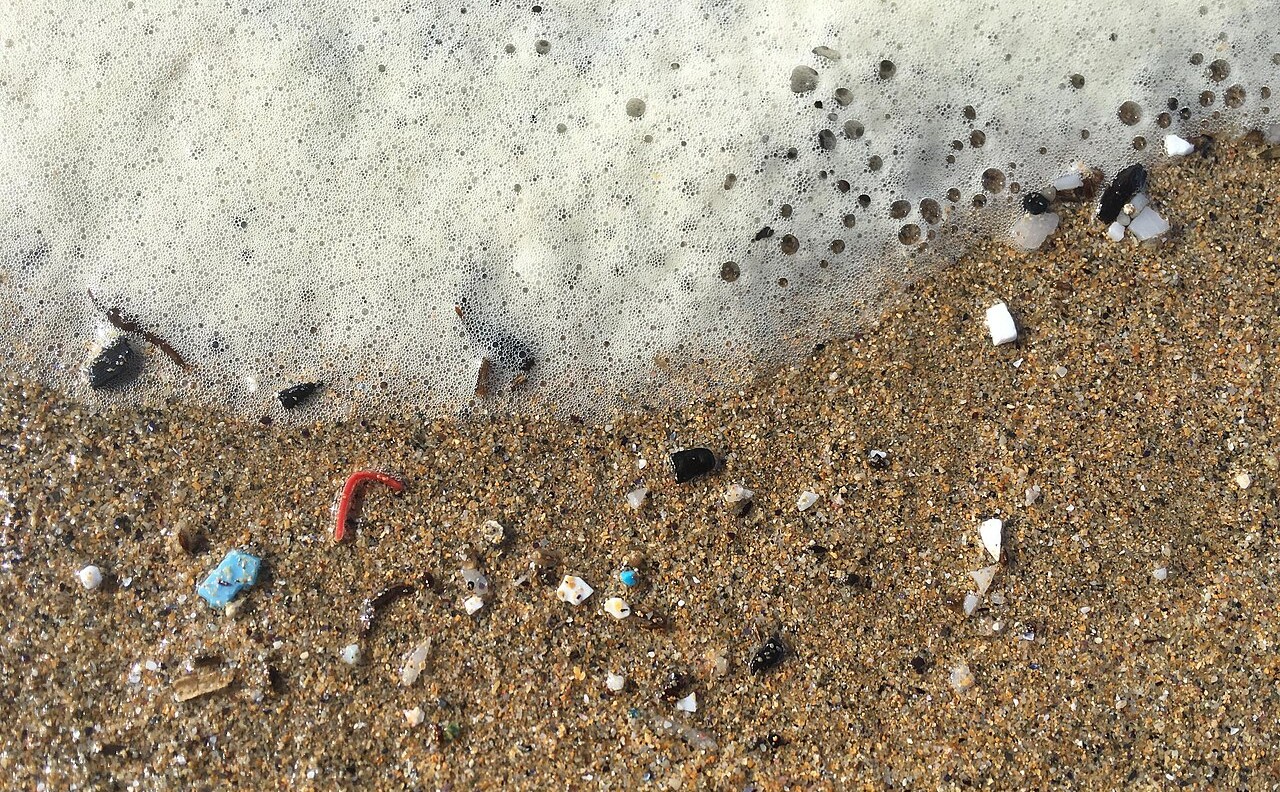
The way microplastics interact with water may explain why they pose health risks that larger plastics don’t, US research finds.
Experiments showed that where tiny pieces of plastic touch water, physical and chemical activity happens that could have biological effects.
These include making proteins clump together, and possibly cell damage.
The Science Media Centre asked NZ experts to comment.
Dr Olga Pantos, Science leader, PHF Science, comments:
“Until recently plastics have been considered to be inert materials which do not interact chemically or biologically with organisms, including humans, and therefore wouldn’t pose a risk. However, a growing body of evidence suggests they can interact with biological systems in a range of ways. Research has linked microplastics to effects from causing chemical toxicity to the promotion of antimicrobial resistance, raising increasing concern about their impact on both environmental and human health.
“This study adds an important new dimension to our understanding of how microplastics can cause harm by showing that they can generate reactive oxygen species (ROS), highly reactive molecules that can damage DNA, proteins and cell membranes and can trigger cell death pathways.
“The findings highlight that there is still much to learn about how these materials interact with living organisms and the wider environment.
“The study also has a more positive conclusion, with the findings considered to be very useful in aiding the development of new plastic materials or alternatives that are safe and sustainable by design. Helping to avoid unintended consequences and false solutions whilst providing the benefits that plastics have brought society. This is so important as we don’t have time to waste in tackling this global pollution crisis.”
Conflict of interest statement: “No conflict of interest.”
Associate Professor Vanessa Morris, School of Biological Sciences, University of Canterbury, comments:
“This article identifies a new way in which microplastics could cause harm. It challenges the long-standing idea that plastics are chemically “inert”, by showing that when microplastics come in contact with water, they can generate reactive oxygen species, which can damage cells and biological molecules at high levels.
“The authors also show that proteins can stick to plastic surfaces, causing the proteins to change shape and clump together (aggregate). Protein aggregation is associated with brain diseases, such as Alzheimer’s and Parkinson’s disease, however, the study did not examine proteins directly linked to these diseases.
“This work builds on existing scientific evidence that suggest that microplastics and nanoplastics are harmful for human health, by providing a possible explanation for their damaging effects. The work could further help us to understand the risks of plastic pollution and to design improved and safer materials in future.”
Note to editors: Associate Prof. Morris’ field is protein aggregation and its role in human disease. She is not an expert in microplastics and their chemistry/physics, but has an interest in reactive oxygen species and microplastics.
Conflict of interest statement: “No COI.”
Our Science Media Centre Korea colleagues have also gathered comments:
June-Woo Park, Principal Researcher, Center for Environmental Safety Research, Korea Institute of Toxicology, comments:
What is the context of this study? What topics related to microplastic activity has the research community recently focused on, and how do these findings relate to those trends?
“Until now, microplastic research has mainly focused on questions that attract interest or curiosity, such as how much microplastic is found in the environment or the human body, and how much is released from plastic products under various conditions. From a toxicological perspective, several papers have reported that microplastics can induce ROS-related harm in living organisms. This study is relevant in that it provides scientific evidence for the mechanism by which microplastics generate ROS.”
What is the most important contribution of these findings, and what are their limitations?
“The key contribution is identifying the mechanism of ROS generation by microplastics in aquatic environments. However, in terms of environmental relevance, a limitation is that the study did not examine nanoscale plastic particles, only microscale ones. Nanoplastic pollution in the environment is considered more hazardous than microplastic pollution.”
Are the conclusions supported by sufficient evidence or data? Are the reasoning and process robust, and were confounding factors adequately controlled?
“Sufficient evidence and data were provided.”
How does this study differ from previous research in terms of data or methodology?
“Previous studies confirmed a link between ROS generation and toxicity (harm). This study differs in that it identifies how ROS are generated.”
How might this study help address the microplastic problem? Could it influence risk prevention or avoidance, or policymaking?
“As a study confirming the hazards of microplastics, it can serve as baseline data for addressing micro- and nanoplastic issues, particularly for developing management policies.”
Buhm Soon Park, Director, KAIST Center for Anthropocene Studies & Endowed Chair Professor, KAIST Graduate School of Science and Technology Policy / Jihye Kim, Postdoctoral Researcher, KAIST Center for Anthropocene Studies, comment:
“Recent studies suggest that micro- and nanoplastics may interact with the environment and living organisms differently from larger, chemically stable plastics. This study is notable because it shows that new chemical activity can emerge at the plastic–water interface as plastic particles become smaller. In particular, the finding that reactive oxygen species (ROS) can form spontaneously at the microplastic–water interface shows that plastics do more than carry or release other chemicals. They can take part in environmental chemical reactions themselves. This suggests that a reduction in plastic size may involve more than physical fragmentation. It may bring a qualitative change in how the material acts chemically, which carries significant potential risks for living organisms and the natural environment.“Above all, this study is significant because microplastics, which have been discussed as one of the “technofossil” of the Anthropocene, are shown not only to be widespread across the globe but also to be capable of actively participating in biochemical processes. If human-made materials can change their properties and behavior after entering the environment, this raises new safety concerns. Plastic pollution therefore cannot be understood simply as a matter of waste generation and accumulation. It calls for attention to the social structures underlying the entire cycle of plastic production, use, and disposal.”